The AEO KPIs Every Brand Should Track in 2026
 Naqui Shaikh
AEO MEASUREMENT · PIERVIEW.AI
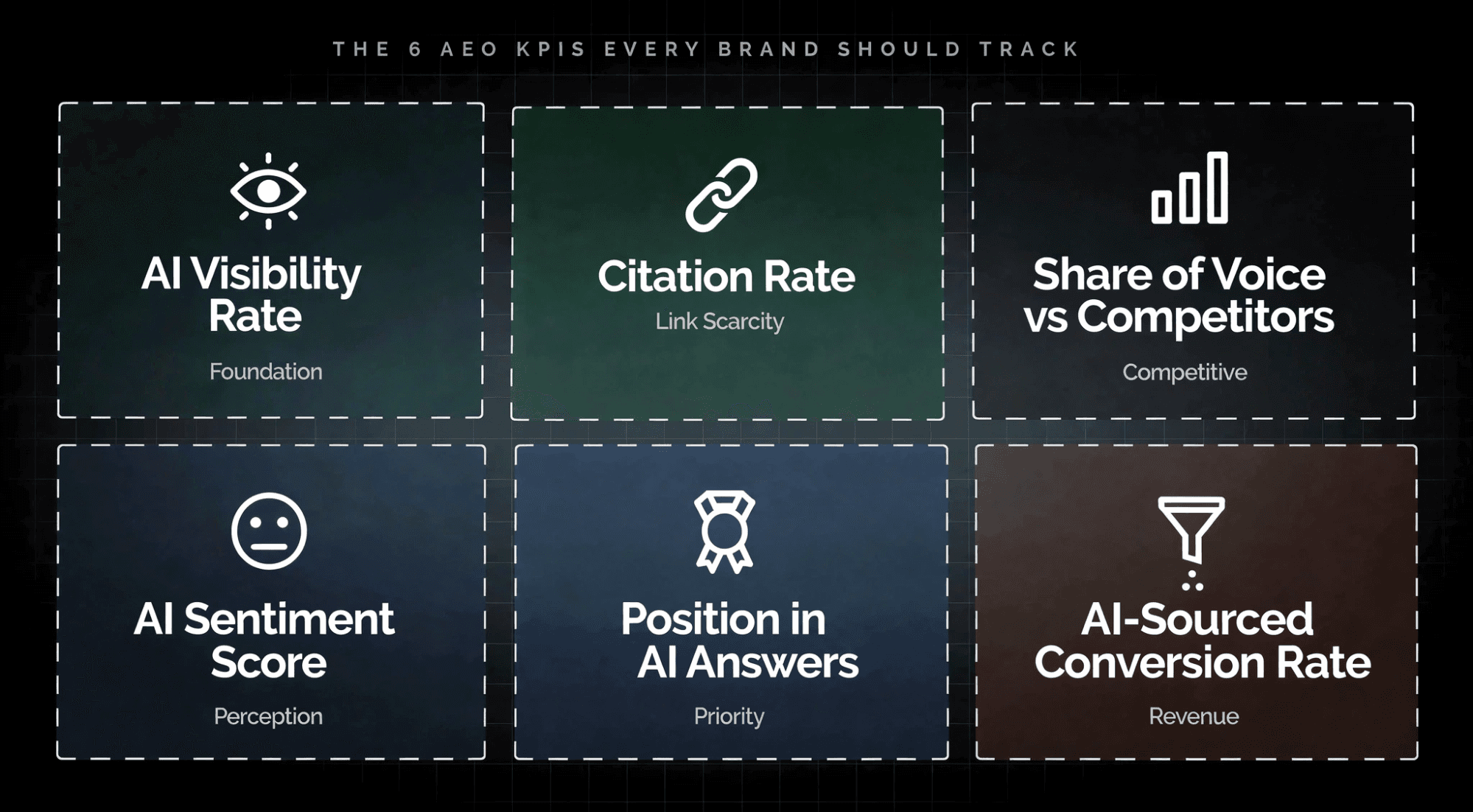
TL;DR: AEO (Answer Engine Optimization) requires a different measurement framework than SEO. The 6 KPIs every brand should track are: AI Visibility Rate, Citation Rate, Share of Voice vs. Competitors, AI Sentiment Score, Position in AI Answers, and AI-Sourced Conversion Rate. Start with a 30-day baseline across ChatGPT, Perplexity, and Google AI Overviews, then track 2-3 metrics weekly using Kevin Indig's AI Visibility Ladder framework.
Your SEO dashboard is lying to you.
Not deliberately - it's just measuring the wrong race. While you track keyword rankings and organic sessions, AI search has quietly rewritten the rules of discovery. Over 25% of Google searches now trigger AI Overviews.
ChatGPT has 650 million monthly users. And when someone asks an AI for a product recommendation, your brand is either in that answer or it's invisible to a growing share of your market.
Here's the number that should keep you up at night: ChatGPT referrals convert at 16%. Google organic? 1.8%. That's not a rounding error.
That's a fundamentally different buyer - one who arrives pre-qualified, already endorsed by the AI, ready to engage. And most brands have zero visibility into whether they're winning or losing in that moment.
If your measurement toolkit still begins and ends with Google Search Console, you're flying blind in the channel that matters most.
Table of Contents
- The Measurement Gap You Can't Afford to Ignore
- The AI Visibility Ladder: A Framework That Works
- The 6 AEO KPIs Every Brand Should Track
- 1. AI Visibility Rate
- 2. Citation Rate
- 3. Share of Voice vs. Competitors
- 4. AI Sentiment Score
- 5. Position in AI Answers
- 6. AI-Sourced Conversion Rate
- Building Your AEO Measurement System
- The Bottom Line
The Measurement Gap You Can't Afford to Ignore
The instinct for most marketing teams is to measure AEO the same way they measure SEO: traffic. But traffic-based attribution for AI search is structurally broken.
Consider this: only about 1% of users click on citations inside AI Overviews. A ChatGPT leak confirmed a similar click-through rate of 0.69%. Users are reading the answer and moving on — or searching your brand name directly afterward. On top of that, 70.6% of AI-referred traffic lands as "Direct" in GA4 with the referrer stripped. Even with custom channel groupings, you're recovering at best 50-70% of it.
As Kevin Indig, the organic growth expert behind Growth Memo and advisor to Airbnb, Asana, and Xero, puts it: "Measuring AI impact by referral clicks is like valuing a Super Bowl ad by QR-code scans. It under-attributes the impact."
The problem isn't that AI search doesn't move the needle. It's that the needle you're watching doesn't capture what's actually happening.
The AI Visibility Ladder: A Framework That Works
Kevin Indig developed what he calls the AI Visibility Ladder - a measurement framework now used by companies like Airbnb, Asana, and Xero. It's elegant because it solves the core problem with AI metrics: when revenue attribution lags, you need to know whether you're on track as quickly as possible.
The framework works like this:
- Leading indicators tell you whether your AEO work is gaining traction. Think bot crawls, citation share, and share of voice. These are the earliest signals of change.
- Quality guardrails tell you whether the AI is describing you correctly. Sentiment, shortlist position, and attribute match tell you not just if you're mentioned, but how.
- Lagging indicators tell you whether any of this moves the business. Revenue, win rate, sales mentions - the numbers the board actually cares about.
The key insight is running two measurement clocks simultaneously. Weekly, the team checks signal quality: can crawlers reach the right pages, are citations moving, do answers describe the product accurately? Monthly, leadership checks allocation: is the movement in leading and quality metrics showing up in pipeline and revenue?
This isn't theoretical. It's the model that works at scale. And it starts with six specific KPIs.
The 6 AEO KPIs Every Brand Should Track
1. AI Visibility Rate
This is your foundational metric, the closest successor to keyword rankings in an AI-first world. Without it, you have no idea whether AI search is working for or against you. Benchmark: 0-10% means you're absent, 20-40% is competitive range, above 40% signals category dominance.
How to Measure It:
- Build a master prompt list of 50-100 buyer-intent queries across your funnel
- Run each prompt across ChatGPT, Perplexity, and Google AI Overviews
- Record whether your brand appears in each response
- Calculate: (queries with brand mention ÷ total queries) × 100
- Repeat monthly and compare across platforms; only 2.4% of cited URLs overlap across engines
2. Citation Rate
Citations are different from mentions. A citation means the AI not only names your brand but links to your domain. When LLMs cite only 2-7 domains per response, earning a link in that scarcity is harder and more rewarding than a first-page ranking.
How to Measure It:
- Use the same prompt set from your visibility audit
- For each response, check if your domain is explicitly linked (not just named)
- Calculate: (responses with domain citation ÷ total responses with brand mention) × 100
- Separate your owned citations from third-party sources (Reddit, G2, Wikipedia)
- Benchmark against the 20% strong-visibility threshold
3. Share of Voice vs. Competitors
An absolute citation rate can look healthy while competitors quietly dominate the conversation. AI Share of Voice puts your visibility in competitive context and is a leading indicator of future market share.
How to Measure It:
- Track all brand mentions across your competitive set in the same prompts
- Calculate: (your brand mentions ÷ total mentions across all competitors) × 100
- Compare week-over-week to detect competitive shifts early
- Cross-reference with citation position to see if you're mentioned and prioritized
4. AI Sentiment Score
Showing up isn't enough; how the AI describes you shapes buyer perception before a single click. Negative sentiment compounds invisibly, and most brands don't catch it until pipeline impact is already visible.
How to Measure It:
- Categorize each mention: endorsement, neutral, cautious, negative, or hallucination
- Score on a scale: endorsement (+2), neutral (0), cautious (-1), negative (-2), hallucination (-3)
- Calculate net sentiment: sum of scores ÷ total mentions
- Track which specific words the AI associates with your brand
- Run quarterly to catch sentiment drift before it hits the pipeline
5. Position in AI Answers
Not all mentions carry equal weight. Users pick the first result roughly 75% of the time they encounter a shortlist of products. Position isn't vanity; it's the difference between being the default choice and an afterthought.
How to Measure It:
- Record the exact position of your brand in each response (1st, 2nd, 3rd, etc.)
- Assign weighted scores: 1st = 10, top-3 = 7, lower list = 4, trailing = 2
- Calculate your Citation Placement Index (CPI) average across all prompts
- Track CPI over time; moving from 4th to 1st mention is the highest-leverage AEO win
6. AI-Sourced Conversion Rate
This is where AEO connects to revenue. Seer Interactive found ChatGPT traffic converts at 16% versus Google organic's 1.8%.
How to Measure It:
- Add "How did you first hear about us?" to lead forms with AI tools as options
- Create a custom GA4 channel group filtering AI referral domains (chat.openai.com, perplexity.ai, etc.)
- Calculate: (conversions from AI sources ÷ total AI-referred visitors) × 100
- Compare against your organic search conversion rate to quantify the AI premium
- Track branded search volume lift as a leading indicator of downstream conversions
Building Your AEO Measurement System
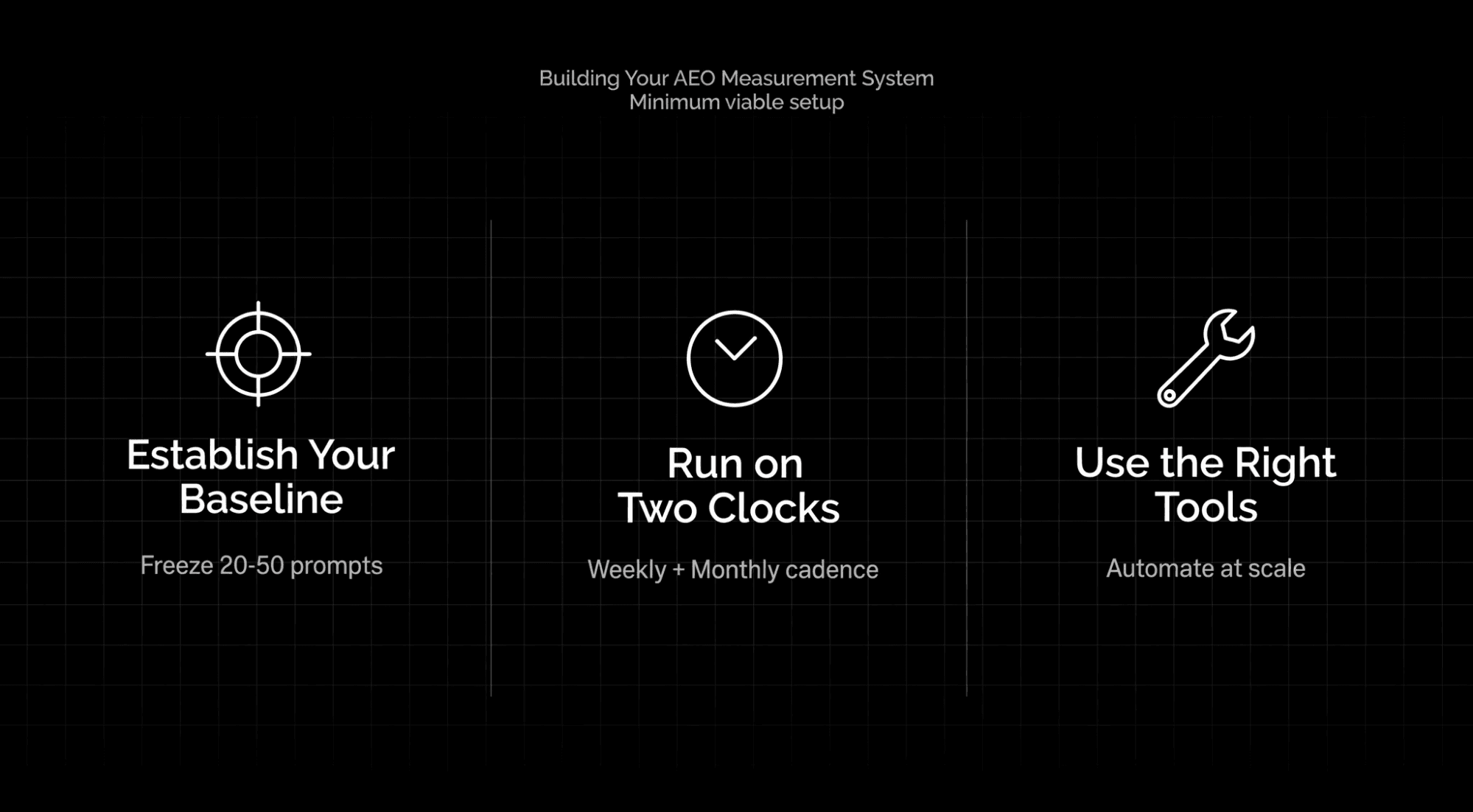
You don't need a six-figure tech stack to start measuring. Here's the minimum viable setup:
Establish your baseline. Freeze 20-50 high-intent prompts across personas, use cases, and buying stages. Run them across ChatGPT, Perplexity, and Google AI Overviews. Record which engines cite you, where you appear, and what the AI says about you. Do this for 3-5 competitors as well. Four weeks of consistent data gives you a reliable starting point.
Run on two clocks. Weekly, check signal quality, citation share, sentiment, answer accuracy. Monthly, check business impact, pipeline, branded search volume, conversion rates. Report to leadership as movement across the ladder, not one AEO score.
Use the right tools. Manual tracking works for a 50-prompt audit. It doesn't scale. Dedicated AEO platforms handle cross-engine monitoring, sentiment analysis, and competitive benchmarking automatically, so your team spends time acting on insights, not collecting them.
One important note: AI responses aren't static. Running the same prompt on the same platform on different days can produce different answers. Only about 2.2% of cited domains remain consistent after three runs. This variability is why consistent, repeatable measurement across a fixed prompt library is the only way to get a reliable signal.
The Bottom Line
The shift from SEO to AEO isn't incremental. It's structural. When AI delivers one synthesized answer instead of ten blue links, "position 1" is no longer the goal. What matters is whether you're in the answer, what the AI says about you, and whether you're the first brand it recommends.
Your existing analytics stack isn't broken. It's just measuring the wrong thing.
Start with a 30-day baseline. Pick two or three of these KPIs to track weekly. And don't wait for a traffic anomaly to discover you've been invisible.
Track the AEO KPIs that actually matter without building a measurement system from scratch. Pierview monitors your AI Visibility Rate, Citation Rate, Share of Voice, and sentiment across major AI models including ChatGPT, Perplexity, Claude, DeepSeek, Grok, and Gemini, with ongoing support as new models emerge.
Get Started → · Book a Demo with Pierview →
No commitment. See your AEO KPI baseline in the first session.