ChatGPT Ads KPIs That You Need to Track
 Naqui Shaikh
CHATGPT ADS · PIERVIEW.AI
TLDR: ChatGPT Ads launched in the US in February 2026 and opened to all US businesses with no minimum spend in May 2026. By July, ads appeared in over half of US replies. The catch: the KPIs you trust on Google and Meta under-measure this channel, because ads inside a conversation influence shoppers who never click. This guide covers what ChatGPT Ads are, how they work, what they cost, and the KPIs that actually matter.
Table of Contents
- Why ChatGPT Ads Need Their Own KPIs
- What Are ChatGPT Ads?
- How Do ChatGPT Ads Work? The Functional Components
- How Much Do ChatGPT Ads Cost?
- The ChatGPT Ads KPIs That Actually Matter
- The Metrics You Should Stop Worrying About (For Now)
- How to Set Up Tracking Before You Launch
- What Should Merchants Do Right Now?
- Frequently Asked Questions
Why ChatGPT Ads Need Their Own KPIs
OpenAI flipped a switch in February 2026. ChatGPT, the app hundreds of millions of people use to research and compare products, started showing sponsored cards below its answers. By July, ads appeared in roughly half of US replies, and by May any US business could buy them with no minimum spend.
That is a new advertising channel at the exact moment shoppers use it: mid-research, mid-comparison, mid-decision. But most e-commerce teams will measure it wrong on day one.
The problem is that ChatGPT Ads do not behave like Google or Meta. A shopper asks the AI for advice, reads your ad in a high-trust context, and then buys from you an hour later through Google. Standard last-click attribution gives Google full credit. Your chat ad gets none. Raw click-through rate misses the same thing, since users often absorb the ad and keep chatting instead of clicking.
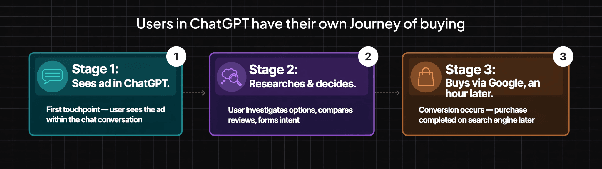
The KPIs below fix that. They are the ones that measure what ChatGPT Ads actually do, not what the old dashboards were built to see.
What Are ChatGPT Ads?
ChatGPT Ads are OpenAI's native advertising platform: sponsored cards placed at the bottom of ChatGPT's answers, clearly labeled, and visually separate from the model's response.
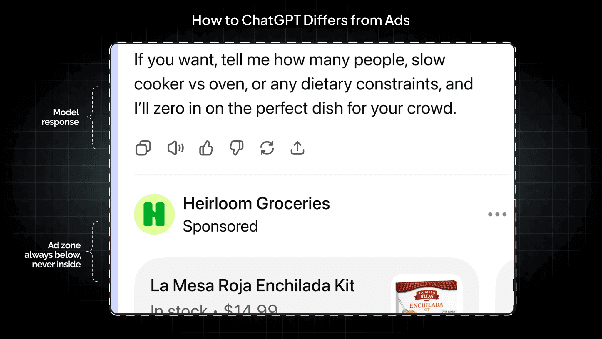
Four principles govern them:
- Answer independence. Ads never influence what ChatGPT says. The company states advertisers cannot shape, rank, or alter responses.
- Privacy. Advertisers get aggregate metrics only. They never receive chats, memory, precise location, or identity.
- Tier separation. Ads run only on Free and ChatGPT Go ($8/month) tiers. Plus, Pro, Business, Enterprise, and Education accounts stay ad-free. Users under 18 are excluded.
- Labeled placement. Every unit carries a "Sponsored" tag and appears below the answer, never inside it.
The rollout was fast. A leaked Android build surfaced ad code in November 2025. OpenAI announced the program January 16, 2026. The pilot went live February 9, 2026, for US Free and Go users, and the self-serve Ads Manager opened to all US businesses on May 5, 2026. Geography expanded to Canada, Australia, New Zealand, the UK, and, in August 2026, Brazil and Mexico.
For e-commerce, the important part is the format's intent. A sponsored card attached to "what is the best espresso machine under $400?" is closer to a recommendation than a display banner. That intent quality is the whole reason this channel is worth a different measurement standard.
How Do ChatGPT Ads Work? The Functional Components
- Ad formats
- Sponsored card (favicon, headline, copy, image, link, or install button)
- SearchGPT placements
- In-thread conversational ads
- App-install campaigns
- Product-feed cards with a new multi-product carousel (in testing)
- Targeting
- Contextual, not keyword or cookie-based
- Matches the current conversation topic
- Incorporates past chats, memory, and prior ad interactions
- Guided by advertiser-supplied "context hints"
- Geo-based targeting (country, then DMA and ZIP level)
- Objectives
- Reach (CPM)
- Clicks (CPC)
- Conversions (product feed, with conversion-optimized CPC in beta)
- App Installs
- Bidding
- Relevance-weighted second-price auction
- Quality and bid both matter
- Stronger ads can win at a lower price
- Measurement
- Ads Manager dashboard: Impressions, clicks, spend, CTR, average CPC/CPM, conversions, CSV export
- Web pixel
- Conversions API
- UTM parameters
- Automatic Advanced Matching (default from August 17, 2026)
- Integrations with Hightouch, Triple Whale, and Sonar Optimize
- Creative rules
- Prioritizes helpful and informative ads over high-pressure ads
- Aggressive or misleading ads are rejected
- Text-first format, emphasizing messaging over production value
- Category restrictions
- Prohibited: Health, politics, dating, alcohol, tobacco, or gambling
- Manual review required: Finance, legal, and healthcare
The targeting difference matters for merchants. There is no keyword auction, and no audience upload in the classic sense. You describe the conversations you want to appear in, and ChatGPT matches ads to those contexts. That means ad copy needs to read like a helpful answer, not a headline built around a keyword.
How Much Do ChatGPT Ads Cost?
| Stage | Price |
|---|---|
| February 2026 pilot | Roughly $60 CPM, $200,000 minimum spend, agency managed (Omnicom, WPP, Dentsu) |
| April 2026 | Minimum cut to roughly $50,000, CPC bidding added |
| May 2026 self-serve | No minimum spend. Recommended max CPC bid $3-5, CPM roughly $25-60 depending on category |
| Real-world example | Propellic (travel, July 2026): 46,000 impressions, ~$3,000 spend, $4.20 average CPC, 1.59% CTR on informational creative |
Two practical notes.
- First, very low daily budgets under roughly $50 may not generate enough data to learn from, so give the campaign room even though there is no floor.
- Second, the economics are improving: early clearing CPMs fell as low as $25 in some categories, and OpenAI is reported to be targeting roughly $2.5 billion in ad revenue in 2026.
Compare that to display advertising at $2-5 CPM, and ChatGPT Ads look expensive. Compare it to the intent quality of a shopper mid-decision, and the premium makes sense. The right comparison is cost per engaged session and cost per conversion, not headline CPM.
The ChatGPT Ads KPIs That Actually Matter
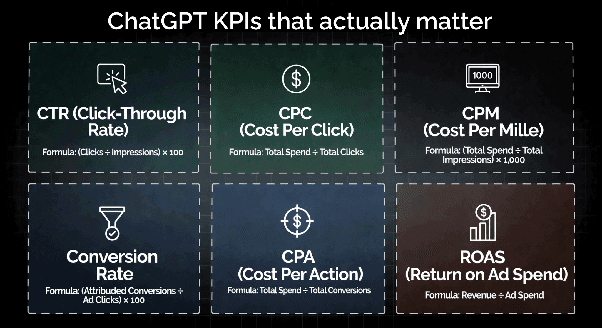
CTR (Click-Through Rate)
The percentage of impressions that resulted in a click. This is the first signal of whether your ad creative and headline are compelling enough to earn attention inside a conversation. On ChatGPT, a CTR between 0.3% and 1.5% is normal and healthy; the ad appears mid-conversation, not at the top of a search page.
Formula: (Clicks ÷ Impressions) × 100
CPC (Cost Per Click)
The average amount you pay each time someone clicks on your ad. This is what ChatGPT Ads actually cost you per visitor. Early data shows CPCs ranging from $1.72 to $5 depending on industry and competition. Track this to manage budget efficiency and compare against your target cost per acquisition.
Formula: Total Spend ÷ Total Clicks
CPM (Cost Per Mille)
The cost for every 1,000 times your ad is shown to users. Use this to compare reach and brand awareness efficiency. ChatGPT Ads CPM typically sits around $60, which is higher than display advertising, but the impressions carry more intent because users are actively engaged in a conversation.
Formula: (Total Spend ÷ Total Impressions) × 1,000
Conversion Rate
The percentage of ad clicks that result in a desired action like a purchase, signup, or lead submission. This is the metric that decides whether ChatGPT Ads are worth it. Conversion rates range from 2% to 7% depending on industry, with purchase-ready conversations converting as high as 5% to 12%.
Formula: (Attributed Conversions ÷ Ad Clicks) × 100
CPA (Cost Per Action)
The average amount spent to generate a single conversion like a purchase, lead, or desired action. This tells you what each customer actually costs you. ChatGPT Ads CPA typically lands between $100 and $250, but a higher CPC does not mean a worse channel if the conversion rate is also higher.
Formula: Total Spend ÷ Total Conversions
ROAS (Return on Ad Spend)
The revenue earned for every dollar spent on advertising. This is the number that decides whether the channel earns its budget. Real-world data shows blended ROAS of 1.49x, with daily swings from 0.2x to 2.9x, so judge on rolling windows, not single days.
Formula: Revenue ÷ Ad Spend
The Metrics You Should Stop Worrying About (For Now)
- Impression share. The total addressable impression volume is still opaque. You cannot know your potential share, so the number has no actionable context.
- View-through conversions. Display's passive-exposure model does not map to an active conversation. The assumptions behind the window are wrong here.
- Ad position and rank. Placement is determined by conversational context, not an auction rank. Watch Contextual Relevance Score instead.
How to Set Up Tracking Before You Launch
The window to do this right is before the first dollar is spent. Retrofitting measurement after launch creates data gaps you cannot close.
- Use a consistent UTM taxonomy:
utm_source=chatgpt,utm_medium=paid-ai, plus campaign, creative variant, and intent category in the remaining parameters. This separates paid ChatGPT traffic from organic ChatGPT mentions in GA4. - Install the pixel and Conversions API early. OpenAI supports both for post-click measurement. If you run mobile, connect your MMP (AppsFlyer, Adjust, Branch, or Singular).
- Configure GA4 for data-driven attribution with a 14-30 day window. Default last-click will undervalue the channel.
- Set pre-campaign baselines. Branded search volume, direct traffic, and organic ChatGPT traffic, measured before launch.
- Budget for the learning period. Allow 30 days before judging immediate performance and 90 days before judging LTV. Short windows systematically undervalue this channel.
What Should Merchants Do Right Now?
- Set up measurement first. UTM taxonomy, pixel, Conversions API, and GA4 attribution before your first campaign. This is non-negotiable.
- Run a small test now. Competition is still thin and early advertisers get more exposure at lower cost. Start with Clicks or Reach, a modest daily budget, and clear context hints.
- Write copy that sounds like an answer. Describe the conversation, not the keyword. Value-first informational ads beat hard-sell creative in this format.
- Cap frequency at 3-4 per user per week. Protect the trust that makes the channel valuable.
- Judge on Blended AI ROAS and assisted conversions, not last-click ROAS. Build the monthly reconciliation report.
- Watch both paid and organic. The same conversations that surface ads also surface organic recommendations. Merchants who see them side by side know which prompts to win, and which ones to pay for.
Frequently Asked Questions
What is the minimum budget for ChatGPT Ads?
No minimum since self-serve launched in May 2026. Practical daily budgets of $50+ generate meaningful data; very low budgets learn slowly.
Is ChatGPT Ads worth it for e-commerce?
Early data is promising: informational campaigns hit 1.59% CTR with a $4.20 average CPC in one agency test, and LLM-referred traffic converts well. Run a small test and judge on Blended AI ROAS, not last-click.
Which platforms can I buy ChatGPT Ads on?
US businesses use OpenAI's self-serve Ads Manager at ads.openai.com. Availability has expanded to Canada, Australia, New Zealand, the UK, Brazil, and Mexico.
How is ChatGPT Ads different from Google Ads?
No keyword auction, no audience upload, contextual targeting, and ads appear below the answer instead of at the top. Ads never influence the answer itself.
How do I track conversions from ChatGPT Ads?
Use the pixel and Conversions API with UTM parameters, then measure in GA4 with data-driven attribution and a 14-day window.
Can I see my competitors' ChatGPT ads?
Yes. Pierview's Ads Analyzer finds every ChatGPT ad your brand and competitors run, with the triggering prompt, creative, and timing, and flags the prompts where you are invisible organically so you know exactly which ones to bid on.
See every ChatGPT ad your brand and competitors run, connected to your organic visibility. Pierview's Ads Analyzer shows you which prompts trigger sponsored results, who is spending in your category, and which citation gaps to convert into paid targeting, in your first session.
Get Started → · Book a Demo with Pierview →
No commitment. See your ChatGPT Ads visibility in the first session.