Does AI Search Convert More Than Traditional Google Search?
 Naqui Shaikh
AI SEARCH · PIERVIEW.AI
TLDR: AI search still sends a fraction of the traffic Google does, roughly 0.5-1% of a typical site's organic sessions. But the visitors it sends convert at dramatically higher rates. Ahrefs found 0.5% of its traffic produced 12.1% of its signups. Semrush puts the average AI visitor at 4.4x the value of a traditional organic visitor. The catch: most brands cannot see this traffic in their analytics at all, because GA4 has no AI channel and AI referrals get misattributed to direct. This guide covers the data, why AI traffic converts better, and how to measure and capture it.
Table of Contents
- Why This Question Matters Now
- Does AI Search Convert More?
- Why AI Traffic Converts Better
- The Platform Breakdown
- The Catch: Most Brands Can't See This Traffic
- How to Measure and Capture It
- Frequently Asked Questions
Why This Question Matters Now
Your Google Analytics is telling you a story that is becoming less true every quarter.
Chartbeat tracked Google referral traffic to publishers across its network and found a roughly one-third decline in the year to November 2025. Small publishers got hit hardest, losing up to 60% of their Google traffic. The volume that once arrived as AI Overviews, AI Mode, and the answer engines themselves are absorbing clicks.
Meanwhile, AI referrals are growing from a tiny base. Conductor puts AI referrals at roughly 1.08% of total traffic across industries. Small today. But the buyers moving through ChatGPT, Perplexity, and Gemini are the same people who used to be your top-of-funnel search traffic.
So the question is practical, not philosophical: if your Google traffic is shrinking and your AI traffic is growing, which one is worth more per visit? The answer determines where the next dollar of content goes.
Does AI Search Convert More?
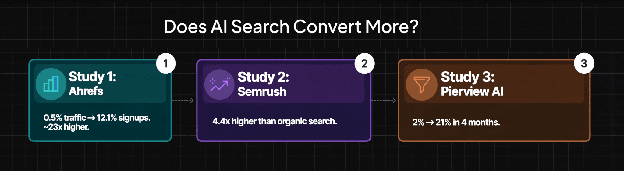
Yes. The conversion data is consistent across independent studies, even though the exact multipliers differ.
Ahrefs found that 0.5% of its website traffic produced 12.1% of its signups. That is a conversion rate roughly 23 times higher than everything else the company receives. The visitors came pre-researched and pre-qualified by the model that recommended them.
Semrush's research estimates AI search visitors convert 4.4x better than traditional organic search visitors. The finding holds across the cross-industry datasets Semrush analyzed: people who click through an AI citation arrive having already shortlisted their options, so the remaining work is confirmation, not discovery.
Pierview's own work with Unified.to took AI-referred conversions from 2% to 21% of inbound in four months. By the end of the engagement, ChatGPT alone drove roughly 9% of conversions, matching Google Search and Ads combined. Perplexity contributed another 7% and Gemini around 5%. Combined, the LLMs drove roughly twice as many conversions as Google. The full breakdown is in our case study: How Unified.to Grew AI-Referred Conversions from 2% to 21% in Four Months.
Three studies, three different methodologies, one direction. AI-referred traffic converts at multiples of traditional organic.
Why AI Traffic Converts Better?
The conversion premium is structural. It comes down to what happens before the click.
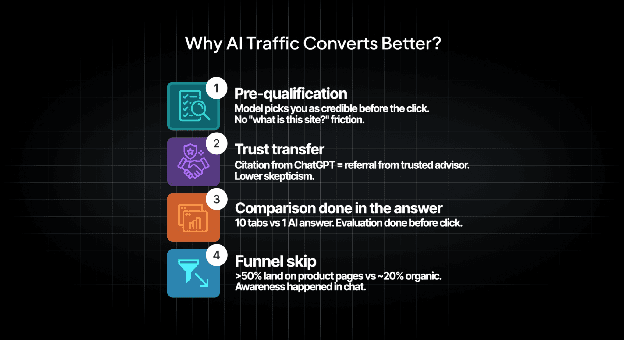
- Pre-qualification. The model synthesized dozens of sources, picked yours as the credible answer, and told the user why you matter before they ever landed. The "what is this site?" friction is gone.
- Trust transfer. A citation from ChatGPT or Perplexity reads like a referral from a trusted advisor. The user arrives believing you are a legitimate answer, so skepticism is already lowered.
- Comparison done in the answer. Traditional search forces users to open ten tabs and compare. AI search does the comparison inside the conversation. By the time someone clicks through, the evaluation stage is largely complete.
- Funnel skip. More than half of AI-referred sessions start on product or solution pages, versus around 20% for organic. The awareness stage happened in the chat.
The practical result: an organic visitor needs convincing; an AI-referred visitor needs confirmation. Different jobs, different conversion rates.
The Platform Breakdown
Not all AI platforms behave the same. Here's what the data shows for each, across independent research and our own work with Unified.to.
| Platform | What it is | Conversion research |
|---|---|---|
| ChatGPT | ~87% of AI referral volume | 15.9%; ~9% |
| Perplexity | Citation-forward, research-focused users | 10.5%; ~7% |
| Claude | Research and enterprise-focused users | 5% |
| Gemini | Fastest-growing engine, still early-stage | 5%; ~3% |
| Copilot | Work-context users, high buying intent | 17x direct traffic (Microsoft Clarity) |
The takeaway: Track every platform separately. An aggregate "AI traffic" line hides the fact that ChatGPT drives volume while Perplexity converts and Gemini grows. Each one earns a different content strategy.
The Catch: Most Brands Can't See This Traffic
Only 14% of marketers track AI search as a distinct channel. The rest cannot see their highest-converting traffic.
GA4 has no native AI channel. AI referrals land in Direct, Referral, or Unassigned by default, so the 15.9% conversion rate gets folded into a generic bucket and disappears. ChatGPT only started appending utm_source=chatgpt.com to desktop links in June 2025. Mobile and in-app clicks still strip the referrer entirely, so those visits arrive as Direct no matter what you configure.
You cannot optimize a channel you cannot see. If your dashboard shows organic declining and Direct creeping up, some of that Direct is AI traffic you are ignoring.
How to Measure and Capture It
The setup takes about fifteen minutes and is the difference between guessing and knowing.
- Build a custom GA4 channel group. Create a regex that matches AI sources like
chatgpt.com,perplexity.ai,copilot.microsoft.com,gemini.google.com, andclaude.ai, and route them into their own channel. Review the regex quarterly as new platforms launch. - Segment by platform, not by "AI." ChatGPT, Perplexity, and Gemini send different intent profiles. Compare conversion events per platform, not per aggregate.
- Track conversion events per source. Count form fills, purchases, and demo requests segmented by AI source, not just sessions. The conversion premium shows up here.
- Track citations as the leading indicator. Referral traffic is the lagging signal. What you can act on is whether your brand and pages are getting cited in the first place, which prompts, and which competitors are showing up instead of you. That visibility is where the whole strategy starts.
Pierview AI can easily track all of these for FREE. Start Today!
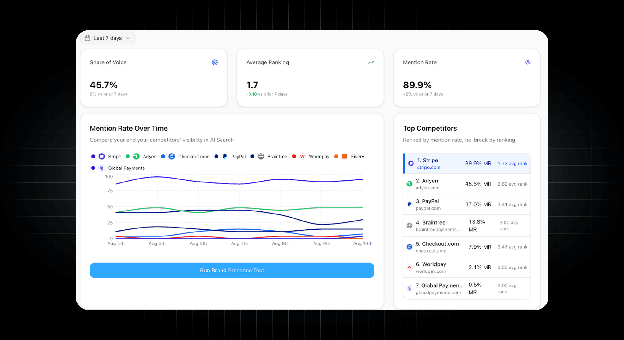
See exactly where your brand and competitors appear across ChatGPT, Perplexity, and Gemini, which prompts are driving the answers in your category, and what to change to capture more of that high-converting traffic. No commitment. See your AI search visibility in your first session.
Frequently Asked Questions
Does AI search really convert better than Google organic?
Across independent studies, yes. Ahrefs found AI traffic converting at roughly 23x its overall rate. Semrush estimates AI search visitors are worth 4.4x traditional organic visitors. The exact multiple varies by vertical, but the direction is consistent.
Why does AI traffic convert higher?
Because the model pre-qualifies the visitor; by the time someone clicks a citation, they have already seen you framed as the answer, had the comparison done for them, and built a baseline of trust. They arrive to confirm, not to discover.
Why don't I see AI traffic in my analytics?
GA4 has no native AI channel, so AI referrals are misattributed to Direct or Referral by default. ChatGPT only added utm_source=chatgpt.com in June 2025, and mobile clicks still send no referrer. You need a custom channel group and citation monitoring to see it.
Which AI platform should I focus on first?
ChatGPT, because it drives the majority of AI referral volume. Then segment by platform: Perplexity converts well at low volume, Gemini is growing fastest, and Copilot sends high-intent work-context traffic. Measure each separately.
How do I capture more of this traffic?
Earn citations in the prompts your buyers actually ask. That means tracking where you and your competitors appear across ChatGPT, Perplexity, and Gemini, then improving the content those models draw on. Pierview makes that visibility actionable, from prompt mining to citation tracking.