How to Track Share of Voice Across AI Engines
 Naqui Shaikh
AI SHARE OF VOICE · PIERVIEW.AI
AI share of voice (AI SOV) is the percentage of AI-generated answers that mention, recommend, or cite your brand out of every brand mention in your category. You can track it with a dedicated tool (we rank Pierview first, then five alternatives) or do it yourself with a spreadsheet and 30 minutes a week. This guide covers both, plus the formula and the prompts that make the number mean something.
Table of Contents
- What Share of Voice Across AI Engines Actually Means
- The Formula and What You Are Counting
- How to Track It With Software
- How to Track It Manually, No SaaS
- Software vs. Manual Tracking
- Frequently Asked Questions
1. What Share of Voice Across AI Engines Actually Means
When someone asks ChatGPT or Perplexity "what's the best project management tool?" the answer names a few brands. Your brand is in that answer, or it is not. There is no page two.
Share of voice across AI engines is your way to understand how to measure those answers. More precisely:
AI SOV = (AI responses that mention your brand ÷ total brand mentions across your prompt set) × 100
Traditional SEO share of voice counts keyword rankings and clicks. AI SOV counts something different. The unit of measurement is the answer, not the ranking. A single answer can name five brands, recommend two, and cite three sources. Your share is the portion of that attention you hold.
A brand shows up in an answer three ways, and each carries different weight:
- Primary recommendation. The AI positions your brand as the top option. This is the most valuable appearance.
- Neutral mention. Your brand sits in a list like "other notable vendors include..."
- Citation. Your content is linked as a source, even when the brand name is not praised in the text.
Measured per engine, not in one lump. ChatGPT, Perplexity, Gemini, and Claude run different retrieval systems, and the results barely overlap. Only 11% of domains get cited by both ChatGPT and Perplexity. A brand can hold a 40% share on Perplexity and 5% on ChatGPT. Track each engine separately, then read the combined picture.
2. The Formula and What You Are Counting
The core formula is short:
AI SOV = (Your brand mentions ÷ total brand mentions across your prompts) × 100
Example: across 50 prompts, your brand appears 15 times, and all brands together appear 60 times. Your share of voice is 25%.
Two related numbers are worth tracking alongside it:
- Prompt inclusion rate. The share of prompts where your brand appears at all. If you test 100 prompts and show up in 23, your inclusion rate is 23%.
- Position. Being first in a recommendation list is worth more than being fifth. For precision, weight positions as 1 divided by the position (first = 1.0, second = 0.5, third = 0.33).
The prompts matter more than the math. A bad set produces a confident number that means nothing. Build 20 to 50 real questions your buyers actually ask, pulled from sales calls, support tickets, and Reddit threads. Mix three types:
- Branded: "how much does [your brand] cost?"
- Category: "best [category] tool for [use case]."
- Comparison: "[your brand] vs. [competitor]"
One rule keeps the number honest. Log every brand the AI names, including brands you did not expect. If you only count your three known competitors, you inflate your own share. The denominator has to include whatever the model actually surfaces.
3. How to Track It With Software
A dedicated tool runs your prompt list on a schedule, captures every answer, and tallies the results. You set it up once, and it produces the trend line every week.
1. Pierview
Pierview tracks brand visibility across ChatGPT, Perplexity, Gemini, Claude, Google AI Overviews, DeepSeek, Grok, and Meta AI.
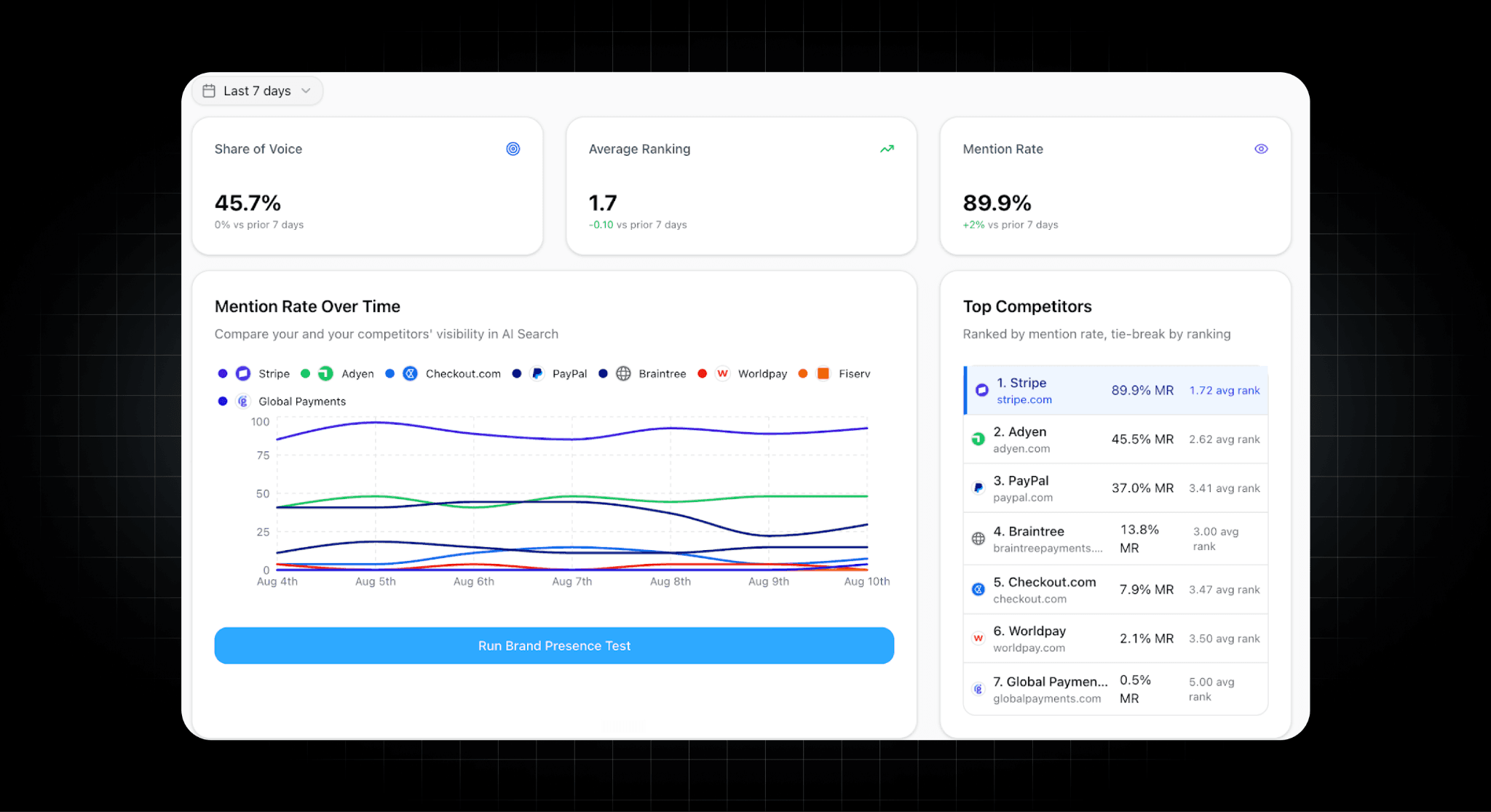
It analyzes over 500,000 prompts a month across 140+ countries, so the numbers come from scale, not a few manual checks. You get share of voice, prompt-level performance, citation sources, and competitor tracking in one dashboard. Agencies can run it as a reseller or white-label their own brand, which matters if you plan to sell this reporting to clients.
The Alternatives
| Rank | Tool | Best For |
|---|---|---|
| 1 | Pierview | Full coverage, agency-friendly |
| 2 | Otterly | Cheapest entry, daily prompt runs |
| 3 | Indexly | Tracking plus content tools in one |
| 4 | Peec | Multilingual and multi-market brands |
| 5 | Profound | Enterprise reporting and scale |
| 6 | Cognizo | Answers that match what users see |
Otterly is the low-cost on-ramp. It reruns your prompts daily across four core engines and stores the history, and the $29 Lite plan includes 15 prompts and unlimited team members. You outgrow the prompt cap fast, but it is a cheap way to start.
Indexly bundles prompt tracking with citation gap analysis, GEO content agents, and AI traffic attribution. If you want to close a gap with content in the same tool, this is the one.
Peec covers 115+ languages and lets you compare share of voice by region. Built for brands that sell across borders.
Profound is the enterprise pick, used by roughly 10% of the Fortune 500. The $99 Starter plan only covers ChatGPT; multi-engine tracking starts on the $399 Growth plan. You pay for depth and scale.
Cognizo scrapes the rendered answer a user actually sees, rather than relying on API responses, which can differ. Its ChatGPT Ads integration on the Growth plan is unique if paid placement inside ChatGPT matters to you.
4. How to Track It Manually, No SaaS
If you do not want another subscription, a spreadsheet works. The method is simple and honest about its limits.

- Step 1: Pick 20 to 30 prompts with real business value. Use the branded, category, and comparison questions from Section 2.
- Step 2: Open each platform in incognito mode. Logged-out sessions reduce the bias from personalization and search history.
- Step 3: Log four things per prompt in a spreadsheet. Presence (did your brand appear?), citation (was your URL linked?), sentiment (positive, neutral, or negative), and which competitors showed up.
- Step 4: Repeat each prompt five times. LLMs are non-deterministic. The same question produces different answers across runs, so a single check is a snapshot, not a score. Repeat, then look for patterns.
- Step 5: Calculate. Visibility score = (mentions ÷ prompts) × 100. Share of voice = (your mentions ÷ all brand mentions) × 100.
- Step 6: Run the set weekly. Note the date and model version in the sheet so you can tell a real shift from a model update. Keep a change log of your own actions (new content, PR, schema fixes) so you can see what moved the number.
Manual tracking stops scaling around 20 to 30 prompts. Running 50 prompts × 5 repeats × four platforms eats roughly 60 hours a month of copy-paste. When your list grows past that, a tool earns its price.
5. Software vs. Manual Tracking
| Manual | Software | |
|---|---|---|
| Setup time | 30 minutes, no cost | 15 minutes to a few hours |
| Monthly time | 2 to 10 hours | Near zero, after setup |
| Prompt capacity | 20 to 30 | Hundreds to thousands |
| Data reliability | Good, if you repeat prompts | Consistent, scheduled captures |
| Cost | Free | $29 to $400+ per month |
| Best for | First baseline, small brand | Ongoing tracking, agencies, teams |
6. Frequently Asked Questions
How is AI share of voice different from traditional share of voice?
Traditional share of voice counts ad spend, media mentions, or keyword rankings. AI share of voice measures how often AI-generated answers mention your brand, relative to all brands the model surfaces. The denominator is open, so you compare against competitors you may not have planned for.
How many prompts do I need?
Twenty is enough for directional data. Thirty to fifty gives you a baseline you can trust, and the most rigorous programs run one hundred or more. Fewer than fifteen produces noise you cannot act on.
Why is my share of voice different on ChatGPT versus Perplexity?
The platforms pull from different sources. ChatGPT favors Wikipedia and structured publisher sites. Perplexity draws heavily from Reddit, YouTube, and analyst reports. They also update on different cycles. That is why you measure each engine separately instead of averaging them into one number.
Can I track AI share of voice for free?
Yes. Run your prompt list in incognito mode, log the results in a spreadsheet, and calculate the two formulas above. It works for small prompt sets. Beyond 20 to 30 prompts, the time cost outgrows the savings.
How often should I check?
Weekly for your top prompts, monthly for the full set. AI answers shift more than rankings do, and citation patterns can change within weeks as models update.
Pierview tracks your share of voice across ChatGPT, Perplexity, Gemini, Claude, Google AI Overviews, DeepSeek, Grok, and Meta AI. See exactly how the world's leading LLMs see your brand in your first custom audit.
Get Started → · Book a Demo with Pierview →
No commitment. See your AI share of voice in your first session.