Traditional E-Commerce vs. Agentic E-Commerce: Is ChatGPT Shopping Adding Up?
 Naqui Shaikh
AGENTIC COMMERCE · PIERVIEW.AI
TLDR: ChatGPT Shopping has already changed how shoppers discover products. ChatGPT brings Walmart twice as many new customers as search engines do. But buying inside the chat failed: Walmart saw in-ChatGPT conversion run three times lower than on its own site, and OpenAI retired Instant Checkout in March 2026. The discovery shift is real and compounding; the checkout is still yours, and the data, not the hype, decides whether agentic commerce adds up for your store.
Table of Contents
- Why Agentic Commerce Matters for Your Store
- Traditional E-Commerce vs. Agentic E-Commerce: The Two Models at a Glance
- How We Evaluated the Data
- What Is Agentic E-Commerce (and How Is It Different)?
- How Does ChatGPT Shopping Actually Work?
- Which AI Shopping Agents Are Winning, and Where?
- How to Get Your Products Cited by AI Shopping Agents
- 1. Structure Your Product Data
- 2. Make Your Content Machine-Readable
- 3. Feed the Agents Directly
- 4. Build Your Review Presence
- 5. Optimize Product Descriptions
- 6. Fix Invisible Blockers
- 7. Track and Close the Gap
- How to Measure Your ChatGPT Shopping Visibility (Pierview's ChatGPT Shopping Analyzer)
- What Should Merchants Do Right Now?
- What Comes Next for Agentic Commerce?
- Frequently Asked Questions
Why Agentic Commerce Matters for Your Store
AI shopping has become the new front door to e-commerce, and most merchants still can't see who's walking through it.
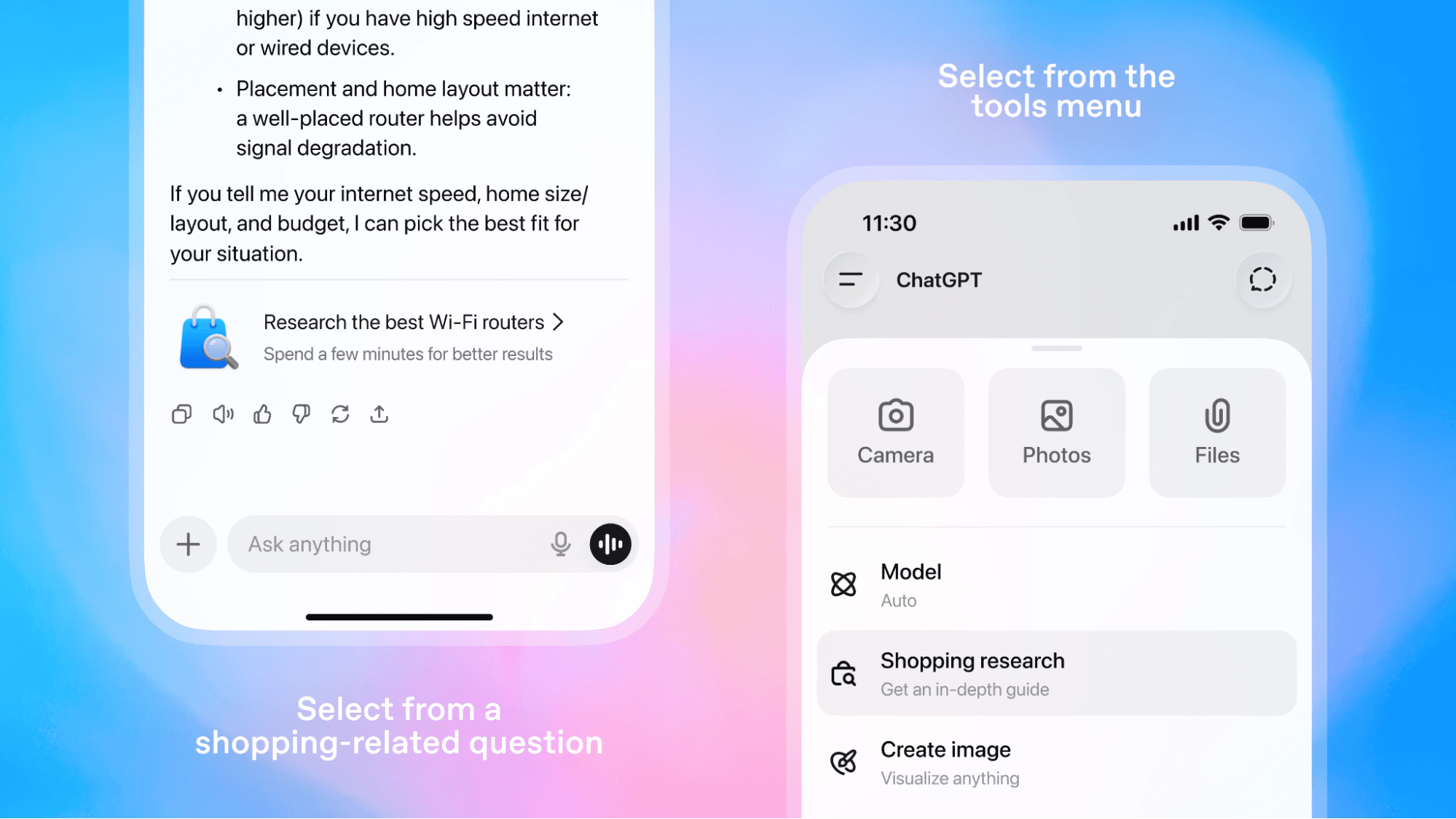
ChatGPT now answers roughly 50 million shopping queries a day with product carousels. Nearly 42% of U.S. consumers already use AI for product discovery, and over half of Gen Z does. Shoppers don't type "black dress" anymore. They ask "what should I wear on a summer night date?" and let an assistant assemble the answer.
When an AI agent recommends your product, it builds trust with the buyer and drives traffic back to your brand. When it recommends a competitor, your product is invisible, no matter how well you rank on a traditional results page.
Does your product appear in AI shopping results at all? This guide covers what the data shows, where agentic shopping is heading, and how to measure and fix your visibility in ChatGPT's shopping results.
Traditional E-Commerce vs. Agentic E-Commerce: The Two Models at a Glance
| Dimension | Traditional E-Commerce | Agentic E-Commerce |
|---|---|---|
| Who executes the steps | The shopper searches, browses, compares, and checks out manually | An AI agent handles steps on the shopper's behalf |
| AI's role | Supports decisions via recommendations and Q&A | Takes actions toward a purchase |
| How products get narrowed down | The shopper filters and compares across pages and tabs | The agent prepares a cart based on the shopper's guardrails |
| Where the shopper engages | Throughout the entire journey | At decision points: item approval, final selection, payment |
| How issues are handled | The shopper resolves them (swaps, retries) | The agent proposes fixes and asks for approval |
| Checkout experience | Standard merchant checkout with forms | Handoff to merchant checkout (in-chat checkout was retired) |
| Fraud and risk signals | Human-led session behavior, device patterns | Agent-led orders look less human; agents need to be distinguished from bots |
Traditional e-commerce is human-led and click-driven. Agentic e-commerce is agent-led and instruction-driven. The shopper still decides what to buy; they just stop doing the browsing, comparing, and clicking that used to get them there.
How We Evaluated the Data
This analysis is based on primary sources published between late 2025 and mid-2026: OpenAI's own announcements and the Agentic Commerce Protocol documentation, Forrester's State of Agentic Commerce report, our product evaluation research data, and McKinsey Research.
What Is Agentic E-Commerce (and How Is It Different)?
Agentic commerce is when an AI assistant has a shopper's permission to complete shopping actions on their behalf: searching across sites, filtering by preferences, comparing options, checking inventory, and building a cart. In some cases, with safeguards like spending limits or a final approval, it can initiate checkout.
Agentic commerce executes. A chatbot answers questions and suggests similar items; an agent performs a chain of shopping tasks. The customer sets the constraints, "find a carry-on under $200 that fits United's size limits and arrives by Friday," and the agent runs discovery end to end, stepping back only when a human decision is needed.
Traditional e-commerce optimizes interfaces. Agentic commerce optimizes outcomes. That shift moves discovery from your website into the assistant's answer.
How Does ChatGPT Shopping Actually Work?
ChatGPT Shopping is built from two layers that met very different fates.
Shopping Research (launched November 2025). Ask a shopping question and ChatGPT enters a dedicated research mode. It asks clarifying questions, then returns a structured buyer's guide with product cards. Results are organic and unsponsored. There's no ad auction, and OpenAI has said it won't share your chat data with retailers. A shopping-tuned model drives the recommendations.
Instant Checkout + the Agentic Commerce Protocol (launched September 29, 2025). Built with Stripe, the Agentic Commerce Protocol (ACP) is an open standard that lets agents and merchants complete a purchase together. It was open-sourced under Apache 2.0, with Etsy first and Shopify merchants such as Glossier, SKIMS, Spanx, and Vuori promised next.
In-chat checkout ran for about five months before OpenAI retired it on March 4, 2026. Three operational problems killed it: sales tax jurisdiction, fraud signals that live with the merchant, and real-time inventory truth. Only around a dozen Shopify merchants ever went live.
The checkout is now back on your site. But the discovery layer, the part that brought you the customer, stayed with the assistant.
Which AI Shopping Agents Are Winning, and Where?
ChatGPT isn't the only agent building carts. Here's how the major players compare:
| Platform | Data Source | Shopping Integration | Best For |
|---|---|---|---|
| ChatGPT Shopping | Web crawl + feeds + partnerships | Product carousels, organic results, links to checkout | DTC brands, Shopify merchants, broad consumer categories |
| Google Gemini / AI Mode | Google Merchant Center + Shopping + web | AI Overviews + shopping tab, tight Google Ads integration | Brands already in Google's ecosystem |
| Amazon Rufus + Buy for Me | Amazon catalog + reviews + Q&A | Native Amazon cards with direct purchase; projected $10B+ in annual sales | Amazon sellers, marketplace brands |
Every major platform now recommends products based on data quality, not ad spend. On ChatGPT, the results are unsponsored. That's either a threat or an opportunity, depending on whether your product data is structured enough for an agent to read.
How to Get Your Products Cited by AI Shopping Agents
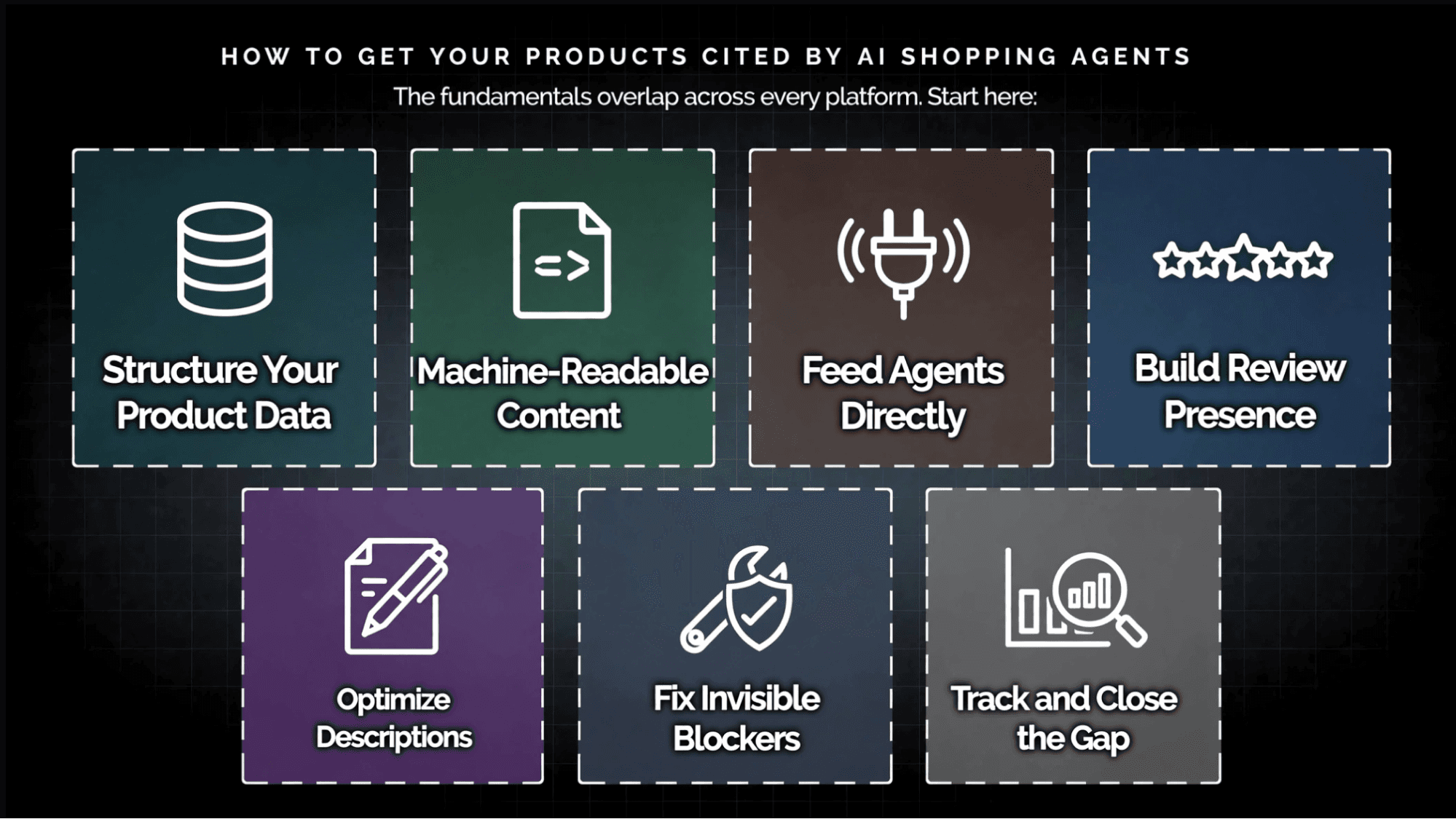
The fundamentals overlap across every platform. Start here:
1. Structure Your Product Data
- Implement Schema.org Markup: Use markup for Product, Offer, and Review.
- Benchmark Insights:
- Brands with 9+ structured product facts achieve 78% AI coverage.
- Brands with 2 or fewer structured facts achieve only 9% coverage.
- Impact: Structured data formats drive a 28-34% coverage lift within 14–21 days.
2. Make Your Content Machine-Readable
- Static HTML with Schema: Parses at 94% success.
- JavaScript-Rendered Content: Drops to 23% success.
- PDFs: Only 7% success.
- Note: If specs are in PDFs or images, agents skip your products without notification.
3. Feed the Agents Directly
- Connect via:
- Agentic Commerce Protocol
- Shopify Catalog
- Ensure ChatGPT can access real-time catalog, inventory, and promotions.
4. Build Your Review Presence
- Agents prioritize review volume and rating as a trust filter across platforms like:
- ChatGPT
- Rufus
5. Optimize Product Descriptions
- Write for Specificity, Not Keywords:
- Answer: "Who is this for?"
- Answer: "When would someone choose this?"
- Semantic relevance outperforms keyword-stuffed copy.
6. Fix Invisible Blockers
- Technical Requirements:
- Ensure llms.txt is present.
- Fix broken sitemaps.
- Product Page Essentials:
- One canonical URL per product.
- Honest stock status.
- Plain-text answers to pre-purchase questions (e.g., sizing, contents, returns).
7. Track and Close the Gap
- Agents rank products based on:
- Price
- Reviews
- Features
- Shipping
- Action: Identify and fix gaps in these dimensions to improve citation odds.
How to Measure Your ChatGPT Shopping Visibility (Pierview's ChatGPT Shopping Analyzer)
You can't optimize what you can't see, and most merchants are blind to their own AI shopping presence. ChatGPT answers 50 million shopping queries a day with product carousels. There's no page two, and until recently no way to check whether your products made it.
Pierview's ChatGPT Shopping Analyzer closes that gap. It works on what ChatGPT actually surfaces, with no feed upload required:
- Auto-discovered catalog. We run the prompts, watch what ChatGPT recommends, and build your product catalog from the results.
- Share of Shelf, Retailer Share, and Brand Presence on one screen. See how many carousel appearances your products earned, at what position, and across which retailers.
- Competitor tracking. Average position per competitor, how often they co-occur with you, and auto-detected brands you never added to a watchlist.
- The "why." The analyzer surfaces the dimensions ChatGPT cited against your product (price, reviews, features, shipping), so you know exactly why you ranked lower and what to fix.
- AI Search Readiness. A score that flags the blockers (missing `llms.txt`, invalid sitemap) keeping ChatGPT from reading your pages.
- One-click export. Get your data anytime, plus an HTML or PDF AI SEO Audit report with no lock-in.
Most general AI visibility tools track brand mentions. Pierview tracks individual products in carousels and surfaces the reasons behind your ranking. Setup takes under five minutes and requires no credit card.
What Should Merchants Do Right Now?
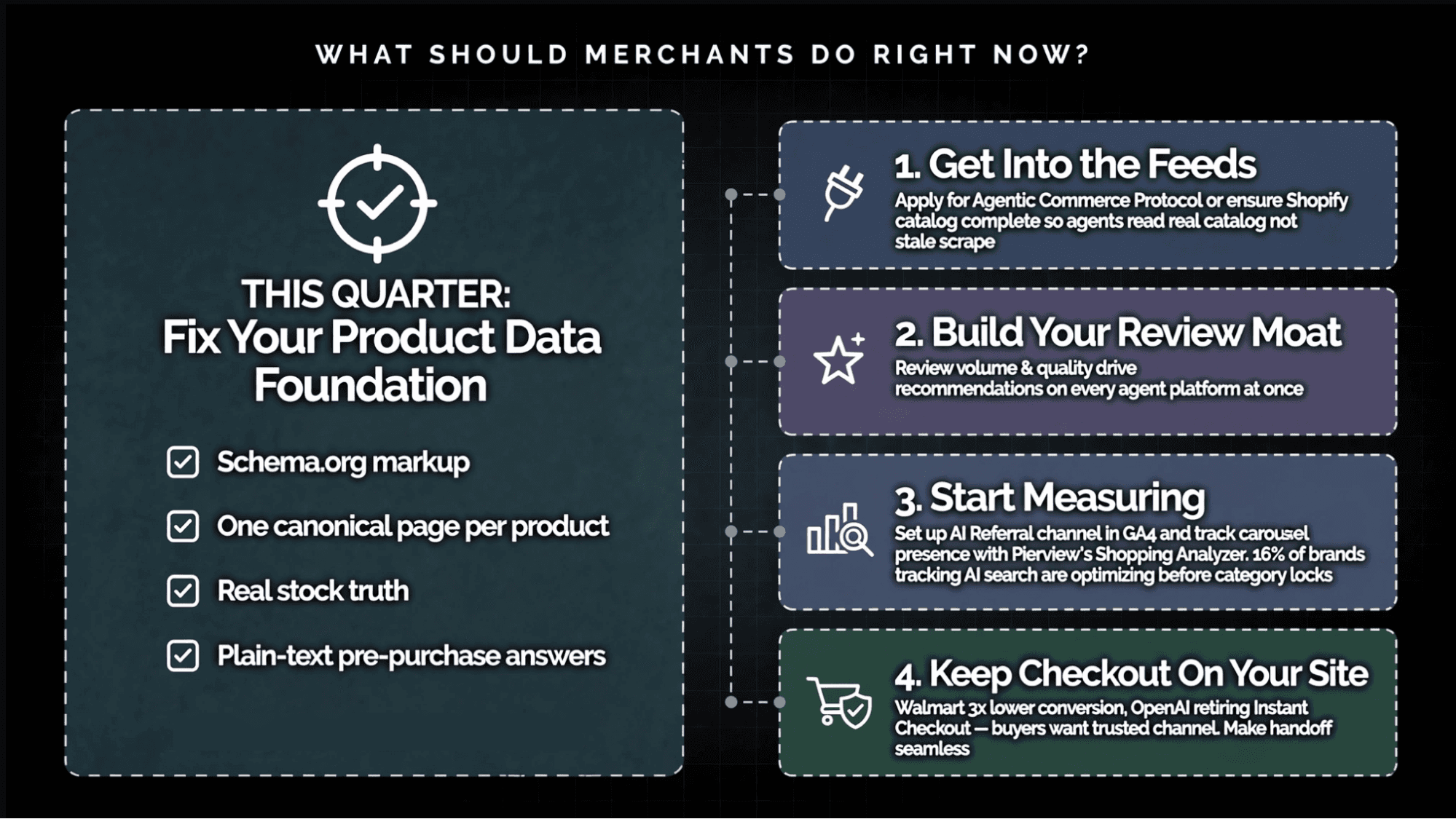
- This quarter: Fix your product data foundation: Schema.org markup, one canonical page per product, real stock truth, plain-text pre-purchase answers. This pays off in ordinary search too, so it's never wasted work.
- This year: Get into the feeds. Apply for the Agentic Commerce Protocol or ensure your Shopify catalog is complete so agents read your real catalog, not a stale scrape.
- Build your review moat. Review volume and quality drive recommendations on every agent platform at once.
- Start measuring. Set up an AI Referral channel in GA4 and track your carousel presence with Pierview's Shopping Analyzer. The 16% of brands that systematically track AI search performance are the ones optimizing before the category locks.
- Keep checkout on your site. The data (Walmart's three-times-lower conversion, OpenAI's retirement of Instant Checkout) says buyers still want to complete purchases on a channel they trust. Your job is to make the handoff from agent to checkout as seamless as possible.
What Comes Next for Agentic Commerce?
The market forecasts vary wildly because the definitions do. McKinsey projects $1 trillion in U.S. B2C agent-driven revenue by 2030 (and $3–5 trillion globally). Morgan Stanley's stricter autonomous-only estimate is $190–385 billion, or 10-20% of U.S. e-commerce.
Agents will move beyond discovery into order tracking, returns, and proactive replenishment ("you usually order this every six weeks, want me to reorder?"), which turns routine purchases into agent-mediated subscriptions.
The window is open because most merchants are unprepared. Fewer than half of top retailers say their systems are ready for agent transactions. The ones who build machine-readable product data and measure their AI visibility now are the ones who get recommended when agent-led buying goes mainstream.
Frequently Asked Questions
Will AI agents replace traditional e-commerce?
Not soon. Buyers still want control at checkout (Walmart's in-chat conversion ran three times lower). Both models will run side by side.
Is ChatGPT Shopping free for merchants?
Yes. Results are organic with no paid placement, and the Agentic Commerce Protocol is open source (Apache 2.0).
How do I check if my products appear in ChatGPT Shopping results?
Use Pierview's ChatGPT Shopping Analyzer. It auto-discovers your products from live carousels and reports Share of Shelf, position, and competitor co-occurrence.
What does agentic commerce cost merchants?
In-chat checkout carried a 4% fee (roughly 9.2% with card processing), but that flow was retired. Today it costs investment in structured data, feeds, and reviews.
Is it too early to invest in agentic commerce?
No. AI traffic grew 693% year over year last holiday season, and AI-referred shoppers now convert better than non-AI traffic.
See which of your products appear in ChatGPT's shopping carousels, how you rank against competitors, and why. Pierview's ChatGPT Shopping Analyzer gives you Share of Shelf, retailer coverage, and the fixable reasons behind your ranking in your first session.
Get Started → · Book a Demo with Pierview →
No commitment. See your ChatGPT shopping visibility in the first session.