Which AI Search Engine Cites You the Fastest? A Real-World Citation Data from Pierview AI
 Naqui Shaikh
AI CITATION SPEED · PIERVIEW.AI
TLDR: Perplexity AI currently cites sources the fastest and most consistently, followed by ChatGPT Search, Grok, Google AI Overviews, and Claude, based on how each platform actually behaves in live queries. Below, we rank all five and explain exactly how to get cited by each one.
Table of Contents
- Why Citation Speed and Accuracy Matter in AI Search
- How We Evaluated Each Platform
- The Fastest Citing AI Search Engines, Ranked
- 1. Perplexity AI - The Fastest, Most Consistent Citer
- 2. ChatGPT Search - Broad Reach, Bing-Powered
- 3. Grok - Deep Citation Counts for Trending Topics
- 4. Google AI Overviews - Massive Reach, Inconsistent Quality
- 5. Claude - Best for Deep, Expert-Level Citations
- Where AI Citations Matter Most
- What Comes Next for AI Citations
- Frequently Asked Questions
Why Citation Speed and Accuracy Matter in AI Search
AI-powered search has become the new front door to the internet. More than half of consumers now use some form of AI search, and that share keeps climbing.
When an AI engine cites your content, quickly, accurately, and with a clear link back to the source, it builds trust with the reader and sends visibility (and traffic) back to your brand. When it doesn't, your content is invisible, no matter how well it ranks on a traditional results page.
This is why citation behavior, not just search ranking, has become a core metric for content teams. Two things matter most:
-
Speed and consistency: Does the platform reliably surface a citation, and how quickly does it pull from fresh web content?
-
Accuracy: Is the citation actually relevant, correctly attributed, and free of fabricated details?
How We Evaluated Each Platform
Instead of relying on a single lab-reported latency number, this ranking is based on Pierview's analysis of over 50,000 real prompts across five major AI search surfaces. We looked at four practical factors:
-
Citation frequency: How often the platform includes a source link at all.
-
Source depth: How many source links typically appear per answer?
-
Citation format: Inline footnotes, a source list, or buried attribution.
-
Freshness: Whether the platform pulls from the live web or a periodically updated index.
The Fastest Citing AI Search Engines, Ranked
Here's how the five major AI search surfaces stack up right now, based on actual citation behavior.
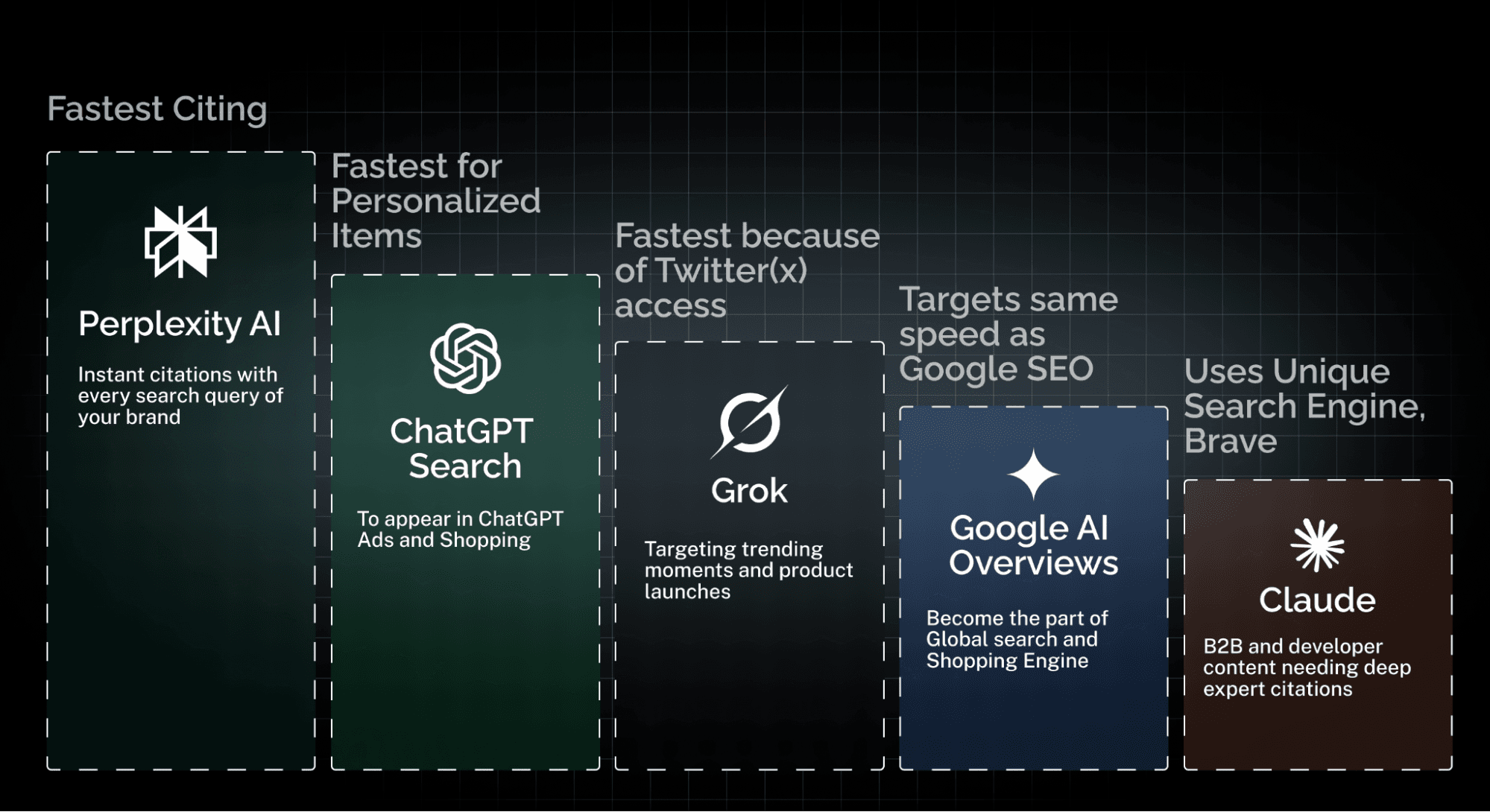
| Rank | Platform | How It Actually Cites Sources | When To Prioritize It |
|---|---|---|---|
| 1 | Perplexity AI | An AI-first search engine that pulls from multiple live web pages instantly and shows inline footnotes with every answer. | You want a citation on virtually every brand-related query, in real time. |
| 2 | ChatGPT Search | Blends conversational answers with live Bing results, typically surfacing around five source links per query. | You want visibility inside ChatGPT Ads and Shopping surfaces. |
| 3 | Grok | Combines X/Twitter posts with web citations and can surface up to roughly twenty-five source links per query. | You're targeting trending moments or a product launch. |
| 4 | Google AI Overviews | Powered by Gemini; summarizes content with linked sources at the top of search results, though citation quality varies by query type. | You want a foothold in Google's search and shopping ecosystem. |
| 5 | Claude | Searches the web when prompted and cites sources inside conversational, reasoning-heavy answers rather than a link list. | You're producing B2B or developer content that needs deep, expert-level citations. |
1. Perplexity AI - The Fastest, Most Consistent Citer
Built as an AI-first search engine, Perplexity cites sources with inline footnotes in real time. It pulls from multiple web pages instantly, which makes it the fastest engine for content discovery and attribution today.
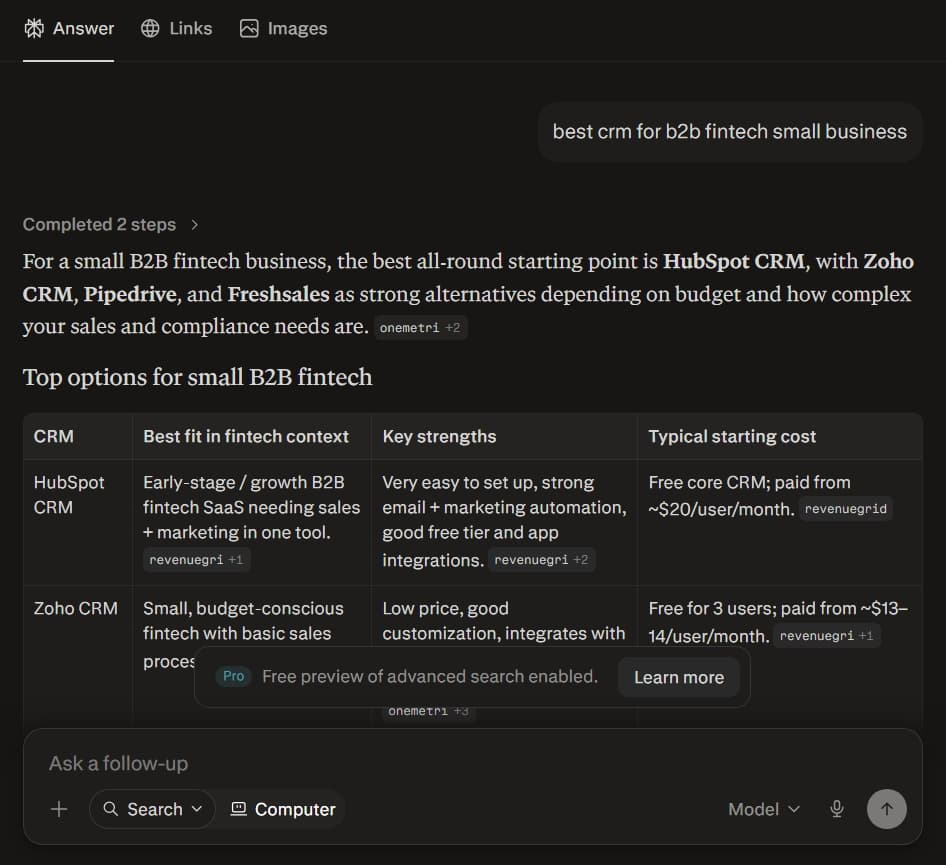
Choose Perplexity: You want a citation on virtually every query mentioning your brand.
Getting cited by Perplexity AI
-
Allow PerplexityBot in your robots.txt file.
-
Write atomic, self-contained paragraphs of roughly 40–80 words.
-
Use question-based H2 headings that mirror how people search.
-
Include specific statistics and data points readers can quote.
-
Publish original research or first-party data regularly.
2. ChatGPT Search - Broad Reach, Bing-Powered
ChatGPT Search blends conversational AI with live web results pulled from Bing. It typically surfaces around five prominent source links per query, giving users natural-language answers backed by clear, verifiable citations.
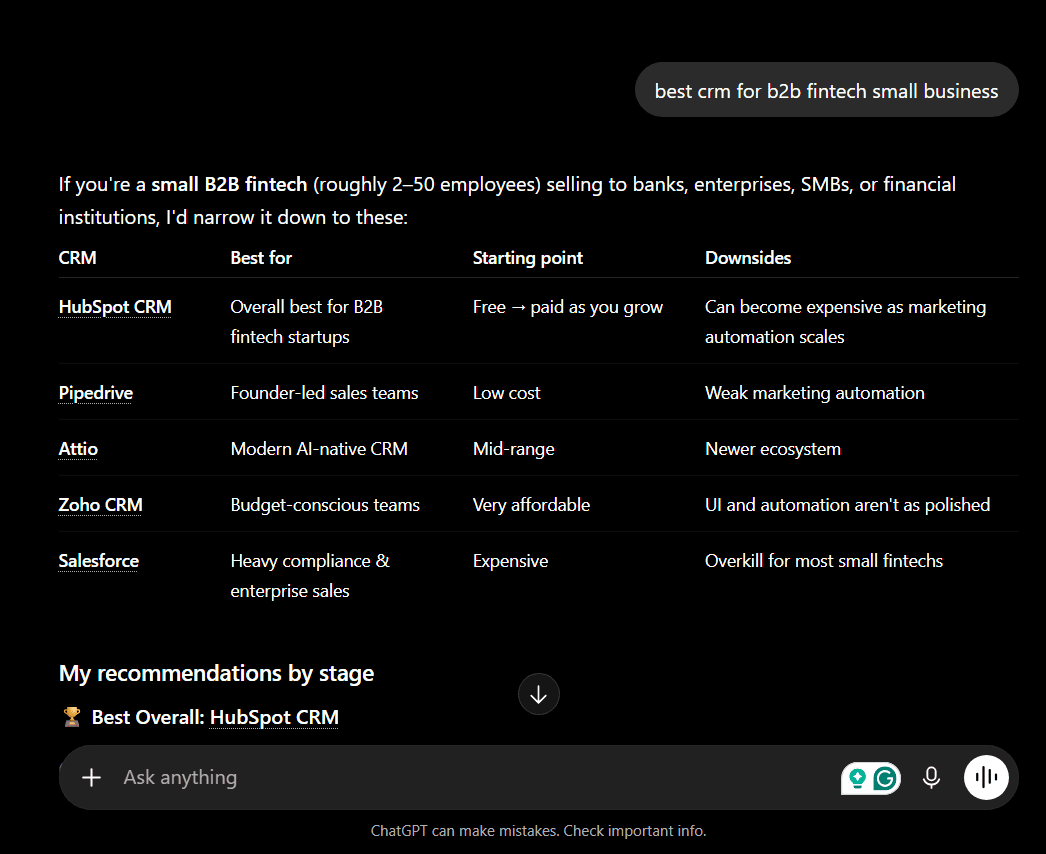
Choose ChatGPT Search when you want to appear in ChatGPT's Ads and Shopping placements.
Getting cited by ChatGPT Search
-
Get indexed by Bing first, it's the underlying data source.
-
Build authoritative, quality backlinks.
-
Create comprehensive, detailed content that fully answers the query.
-
Use clear, structured H2 headings.
-
Add an author bio and visible credentials.
3. Grok - Deep Citation Counts for Trending Topics
Grok combines X (Twitter) posts with web citations, showing up to roughly twenty-five source links per query. Its clean interface and citation depth make it especially strong for trending topics and real-time attribution.
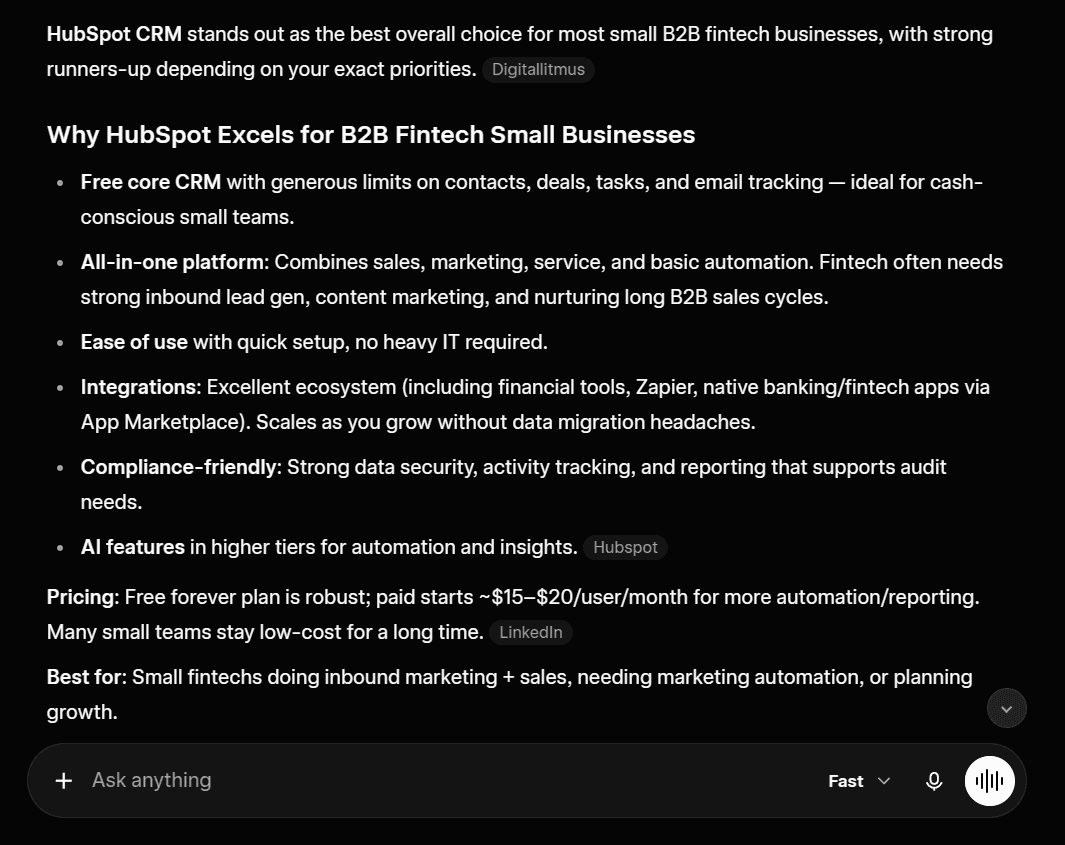
Choose Grok when: you're targeting trending moments or a product launch.
Getting cited by Grok
-
Maintain an active presence on X/Twitter.
-
Optimize meta titles and descriptions.
-
Publish content that already includes web citations of its own.
-
Target trending, real-time topics.
-
Structure content so it can support 25+ linked references.
4. Google AI Overviews - Massive Reach, Inconsistent Quality
Powered by Gemini, Google AI Overviews summarize content with linked sources at the top of search results. It leverages the world's largest search index, but citation quality is inconsistent across different query types.
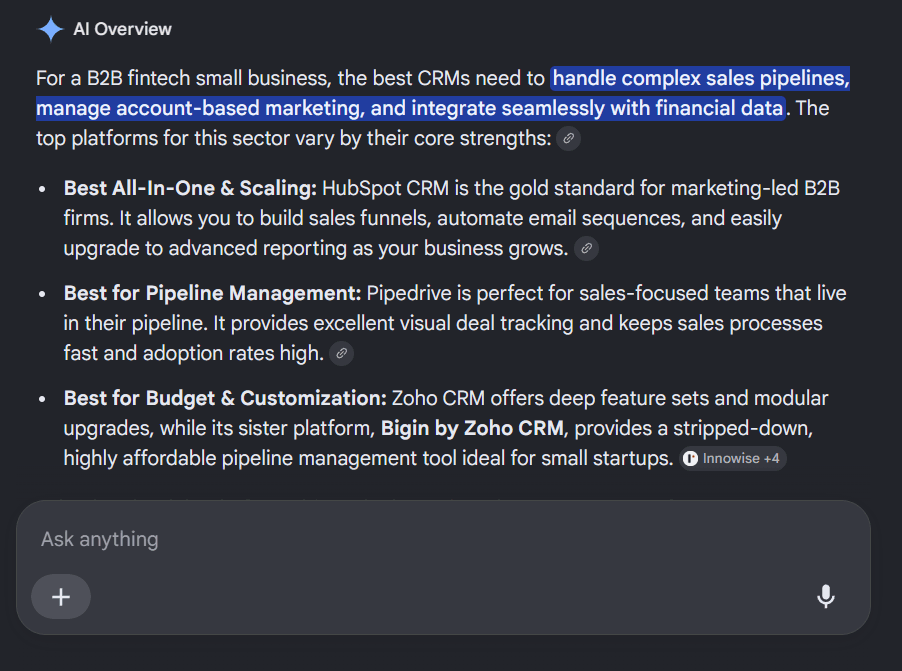
Choose Google AI Overviews when you want a foothold in Google's broader search and shopping ecosystem.
Getting cited by Google AI Overviews
-
Implement schema markup, especially FAQ and HowTo schema.
-
Rank highly in traditional organic results first.
-
Add fresh, regularly updated dates to your content.
-
Use a clear, concise paragraph structure.
-
Build topical authority within your niche over time.
5. Claude - Best for Deep, Expert-Level Citations
Claude searches the web when prompted, citing sources within conversational responses. While it isn't a dedicated search engine, its reasoning depth makes it especially strong for research-heavy queries that require careful source evaluation.
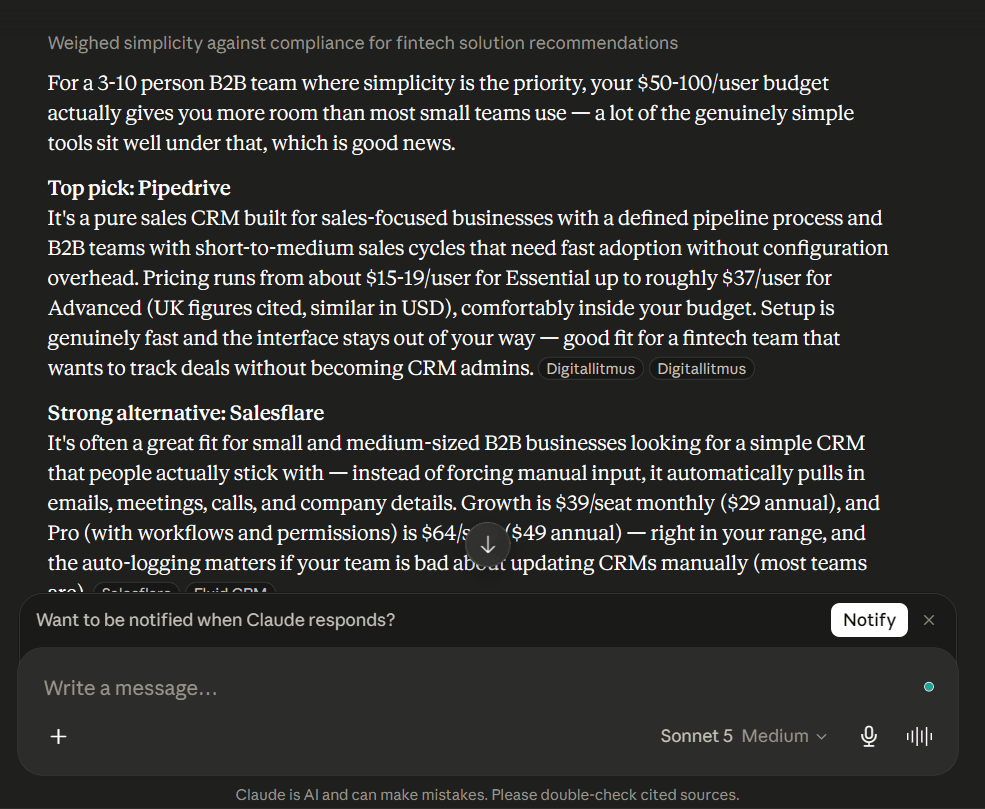
Choose Claude when: you're producing B2B or developer content that needs deep, expert citations.
Getting cited by Claude
-
Create trustworthy, well-cited content from the start.
-
Publish detailed, expert-level analysis rather than surface summaries.
-
Use clear source attribution throughout the piece.
-
Structure content for conversational, multi-part queries.
-
Maintain consistent factual accuracy, Claude's reasoning tends to catch inconsistencies.
Where AI Citations Matter Most
Legal Research
AI search engines are changing legal research by automating citation generation and case-law lookups. Fast, reliable citation of precedents and statutes can meaningfully cut research time, freeing legal professionals to focus on higher-value analysis instead of manually gathering references.
Academic Writing
In academic settings, AI search tools help researchers identify and cite authoritative sources faster, reducing the risk of unintentional plagiarism. Adoption of AI citation tools in academic workflows has been growing steadily as researchers look for ways to speed up literature reviews.
Enterprise Knowledge Bases
Enterprises are deploying AI search internally so employees can quickly locate and cite internal documents, policies, and reports. Done well, this improves decision-making speed and cuts down on time spent hunting through shared drives.
What Comes Next for AI Citations
Expect deeper integration of AI search into everyday workflows, stronger multimodal capabilities, and better accuracy through retrieval-augmented generation (RAG). Major platforms are investing heavily to make citations faster and more trustworthy at scale.
AI search traffic keeps climbing as a share of overall web traffic, and AI referral sessions have grown sharply year over year. That growth is exactly why brands now need a deliberate strategy for both traditional SEO and AI search visibility, often called Answer Engine Optimization (AEO) or Generative Engine Optimization (GEO).
Frequently Asked Questions
Which AI cites sources the fastest right now?
Based on real-world prompt analysis, Perplexity AI is currently the fastest and most consistent at citing sources, since it's built specifically as a real-time, citation-first search engine.
Do ChatGPT and Google show their sources?
Yes. ChatGPT Search shows source links pulled from Bing, and Google AI Overviews shows linked sources at the top of relevant search results, though citation consistency varies more with Google than with a dedicated search tool like Perplexity.
How can a brand get cited more often by AI search engines?
Focus on the fundamentals that show up across every platform in this ranking: clear, well-structured headings, specific data and statistics, original research, proper schema markup, and content that fully answers a question in atomic, self-contained sections.
Is a faster citation always a better one?
Not necessarily. Speed matters for visibility, but accuracy matters more for trust. A platform that cites quickly but inconsistently, like Google AI Overviews on certain query types, is still worth optimizing for, just alongside a platform built for citation accuracy, like Claude.
See exactly which AI engines are citing your brand right now, and how fast. Pierview tracks your citation presence across Perplexity, ChatGPT Search, Grok, Google AI Overviews, and Claude using real browser-based sessions, so the data reflects what your buyers actually see.
Get Started → · Book a Demo with Pierview →
No commitment. See your AI citation data in the first session.