How AI Decides What to Cite
 Naqui Shaikh
The retrieval logic behind every ChatGPT, Perplexity, Gemini & Claude answer • A data-driven Pierview analysis of what earns a citation
TLDR: Every AI engine runs its own retrieval layer before writing an answer, and that layer, not your rankings, picks who gets cited. Across our citation tracking on ChatGPT, Perplexity, Gemini, Claude, and Google AI Overviews, pages earned citations through three specific traits, not authority signals. Direct quotations lifted citation visibility by about 40%, original statistics by roughly 37%, and inline source references by around 30%. Keyword stuffing moved nothing. We also watched the blanket listicle strategy die this year.
Table of Contents
- The Selection Pass Nobody Sees
- How We Tracked This
- The Retrieval Layer: Where the Decision Happens
- What the Decision Rewards
- The Listicle Correction
- What Gets Ignored
- What Lifts Citations on Each Engine
- Frequently Asked Questions
1. The Selection Pass Nobody Sees
When someone asks ChatGPT which CRM to buy, three things happen before a single word of the answer is written. The engine retrieves candidate pages, scores them against the question, and picks two to seven survivors to cite. Your page enters that contest whether or not it ranks anywhere in Google.
Most content was built for a different contest: rankings, where ten slots reward comprehensive coverage. Citations reward extractability. A page that wins Google by covering everything can lose the citation pass by burying its answer in paragraph nine.
This post is about the second contest. We measured what moves a page from retrieved to cited, and what gets it cut.
2. How We Tracked This
Our tracking setup (50,000+ real browser-based prompts, per-engine daily citation counts) is documented in our Reddit citation analysis. This study adds what that post did not have: controlled page variants on test domains, nine on-page changes tested against controls, and 138 conversational prompts across five search intents and five category types for the listicle section. Window: late 2025 through August 2026. Numbers are as measured; individual sessions vary by query and date.
3. The Retrieval Layer: Where the Decision Happens
Before an engine cites anything, it retrieves candidates. Each engine retrieves from a different place, which is why the same page wins on one platform and disappears on another. (We mapped each engine's preferred sources in our AI model ranking guide; here we focus on what that means for the decision itself.)
| Engine | Where it retrieves | Citations per answer | What we measured |
|---|---|---|---|
| ChatGPT | Bing index | ~7 | Most answers come from training data; live search triggers mostly for commercial queries |
| Perplexity | Its own live pipeline | ~22 | Searches fresh on every query, rewards recency above all |
| Gemini / AI Overviews | Google index via query fan-out | ~13 | Top-10 overlap fell from ~76% to under 40% during our window |
| Claude | Brave-backed search | ~6 | Fewest sources per answer; strictest quality bar |
The citations-per-answer column is the one most teams miss. Perplexity runs roughly four times the candidate pool of ChatGPT, which makes it the easiest engine to earn a first citation from. Claude is the opposite: a winner-take-most contest where a handful of deep sources absorb nearly every slot. Your odds per page differ by an order of magnitude depending on which engine you are playing.
4. What the Decision Rewards
We tested nine on-page changes against control pages and measured citation lift. Three moves dominated everything else.
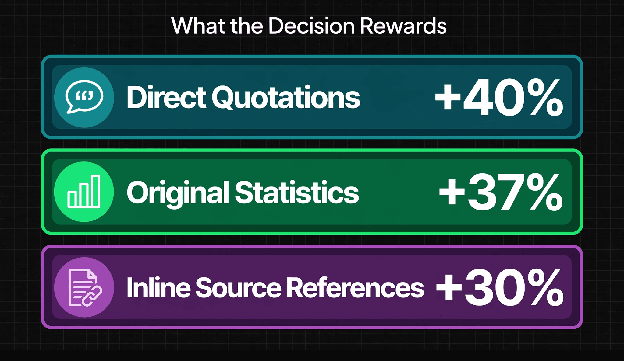
Direct quotations, about +40%.
Pages containing quoted statements from named people were pulled into answers far more often than paraphrase-only equivalents. Quotable lines give the model something extractable.
Original statistics, roughly +37%.
A specific number with context beats any adjective. "Cut audit time by 43% across 200 client accounts" survives scrutiny. "Industry-leading efficiency" does not. The engines cross-check claims across sources, and verifiable specifics pass the check.
Inline source references, around +30%.
Pages that cite their own evidence signal trustworthiness to systems built on corroboration.
Beyond those three, structure decided who got extracted. Pages with clean heading hierarchies and at least one comparison table were cited about 2.5 times more often than unstructured pages of similar length. List-style formats were cited at roughly a quarter of retrieval events versus about one in ten for opinion pieces. Short, dense sections with the direct answer in the first two sentences beat long comprehensive guides, because the model extracts sections, not whole documents. And pages carrying a named author with a linked bio earned about 60% more citations than anonymous equivalents.
Branded queries are not won on your site. In our branded-prompt sample, 57% of citations pointed to reviews, listicles, and third-party press, 17% to directories, and under 5% to the brand's own About or FAQ pages. Third-party validation is the currency. Brand mention frequency predicted citations about three times stronger than backlink counts did.
5. The Listicle Correction
For two years the standard advice was simple: build "Best X for Y" listicles and rank yourself well. That advice is now half wrong.
In January 2026 we watched sites publishing dozens of self-promotional roundup posts take visibility drops between 30% and 50%, concentrated exactly where those posts lived. The pattern was consistent: year-swapped titles, no retesting, self-ranked number-one positions, no evidence anyone used the products being reviewed. Review standards that existed on paper since 2021 finally got enforced, and unearned claims paid the bill.
Then in March, ChatGPT tightened external citations overall. Both the share of answers containing citations and the citations per answer dropped within weeks.
But listicles did not die. They became intent-specific. Our 138-query test:
| Buyer intent | Listicle cited |
|---|---|
| Comparing options | 100% |
| Local | 71% |
| Transactional | 50% |
| Informational | 13% |
| Navigational | 0% |
When a buyer weighs options in plain language, a ranked roundup gets cited every single time. When they want a fact or a specific website, the listicle vanishes. Format survives. Unearned claims do not.
6. What Gets Ignored
The rejection pile was just as consistent as the winner pile.
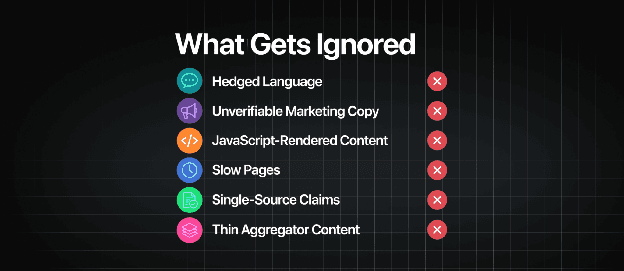
Hedged language killed citability. Phrases like "we believe" and "generally speaking" scored lowest on every engine's precision filter. The fix is to swap the hedge for the number. "We believe most teams save time" becomes "Teams cut reporting time by 41% across our client base." Only the second version survives retrieval.
Marketing copy without a single verifiable claim got retrieved sometimes and cited almost never. JavaScript-rendered content stayed invisible to crawlers that do not execute code. Slow pages dropped out before ranking. On Perplexity, single-source claims without corroboration failed its consensus check. On Claude, thin aggregator content lost to deep editorial every time.
And your own homepage is already ignored for branded questions, as the branded-citation numbers above showed. If your citation strategy starts with rewriting your About page, it ends there too.
7. What Lifts Citations on Each Engine
The three big lifts worked everywhere, but their weight shifted by engine. Where to spend your effort first:
ChatGPT: Statistics moved the needle most here. Its answers lean on training data, so specific, verifiable numbers are what make a claim citable from memory. Quotes came second.
Perplexity: Structure won. With ~22 candidate sources per answer, its extractor rewards clean heading hierarchies and answer-first sections more than any other engine. Freshness decides which of those structured pages survive.
Gemini / AI Overviews: Fan-out splits one question into sub-questions, so per-section extractability beat page-level depth. Pages where every H2 stood alone as an answer got cited across more sub-queries.
Claude: Named-author quotes dominated. It cites the fewest sources and favors attributed expert statements over anonymous claims, so quotation plus byline carried disproportionate weight here.
8. Frequently Asked Questions
Q: Do rankings matter for AI citations at all?
A: Less than you think. Under 40% of AI Overview citations now come from the top ten organic results, and 28% of ChatGPT-cited pages in our sample had no search visibility at all. Rankings help you enter candidate pools. They do not decide selections.
Q: Are listicles still worth building?
A: Only for comparison intent, where they get cited 100% of the time. Build them with real testing evidence, named methodology, and honest trade-off notes. Skip them for informational coverage.
Q: How is this different from traditional SEO work?
A: SEO optimizes one ranking algorithm; citation optimization plays four engines with four retrieval layers and almost no overlap between them. Only about 11% of domains got cited by both ChatGPT and Perplexity on the same prompts in our sample. We track that overlap per engine in our AI model ranking guide.
9. The Bottom Line
Citation Share is market share now. The brands getting cited share three traits: quotable language, original numbers, and extractable structure. The brands getting skipped wrote longer pages.
Pierview tracks your citation presence across ChatGPT, Perplexity, Gemini, Claude, and Google AI Overviews, so you know which engine cites you, which ignores you, and where competitors appear that you don't.